A controversy and division among San Francisco residents between those who see homelessness as moral imperatives to help or homelessness as a threat in the neighborhood
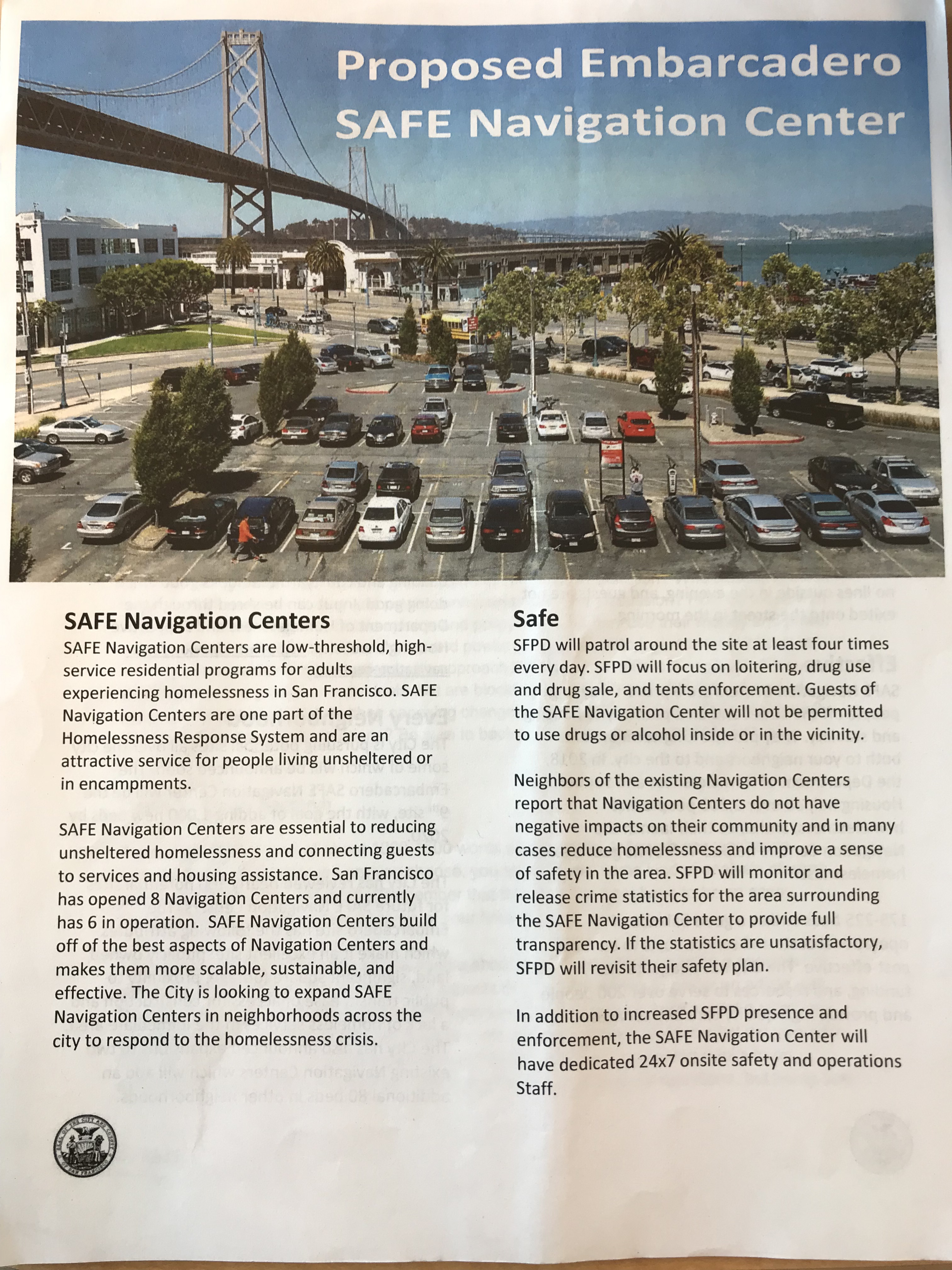
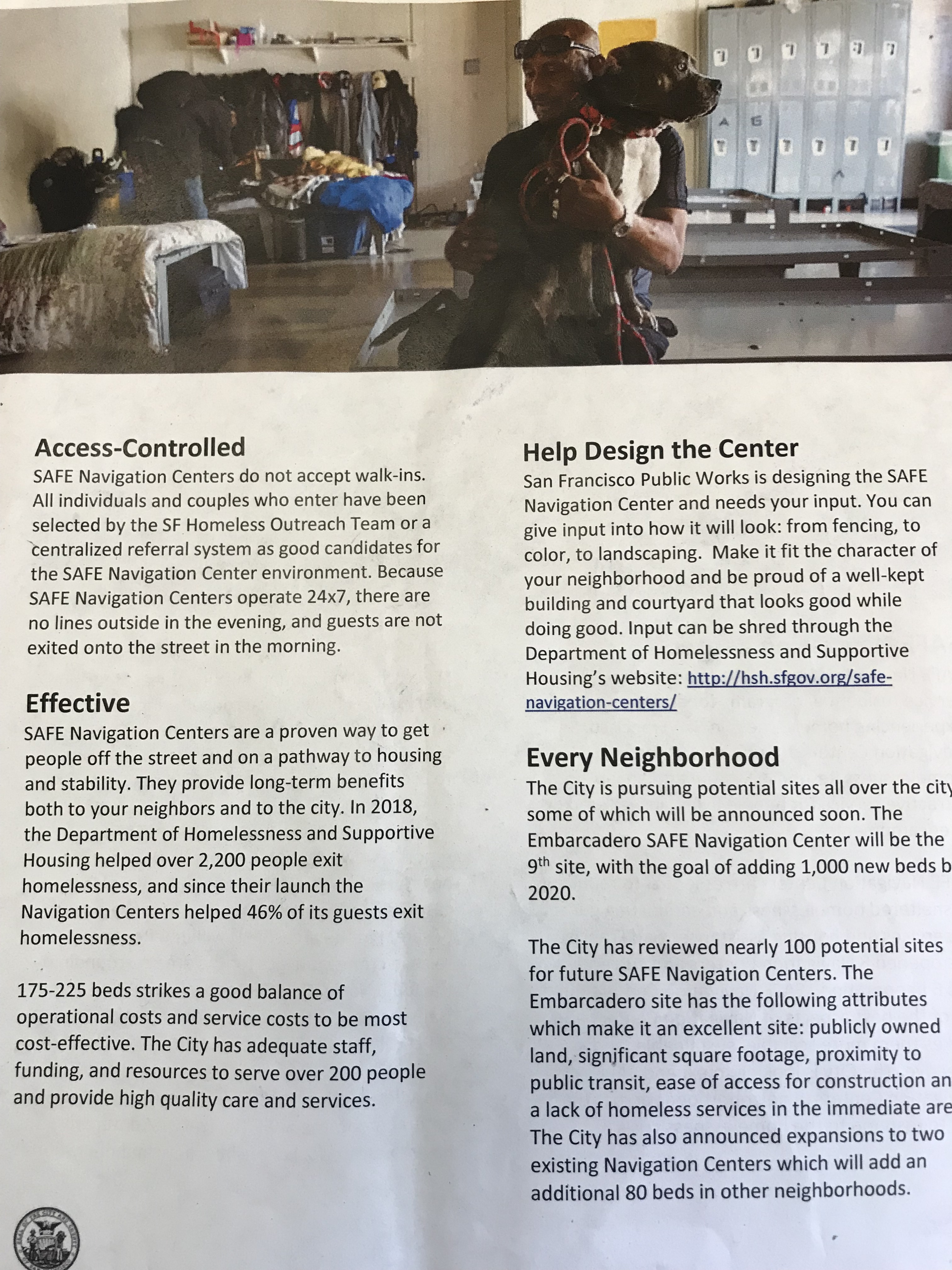
A flyer from Department of Homelessness and Supportive Housing describing SAFE Navigation Center as a safe, “high-service” residential programs for homeless people.
On April 3, 2019 at 6 p.m, San Francisco’s Department of Homelessness and Supportive Housing (DHSH) held a community meeting to introduce the opening of the new “Embarcadero SAFE Navigation Center,” which is to be built in Summer of 2019.
The new proposal and this meeting aroused a lot of controversy and division among San Francisco community between those who see solving homelessness as moral imperatives of residents and those who see homelessness as potential risk to safety in their neighborhood. The meeting was held at Delancy Street Foundation at 600 Embarcadero, and the room was packed to its capacity of 200 people with the city workers, armed police officers, camera and news crews, supporters of the project, and residents of surrounding South Beach condominiums, most of whom oppose the plan. DHSH found Seawall Lot 330 in Embarcadero to be an ideal property for the city’s largest 200-bed Navigation Center, which will address the current homeless crisis.
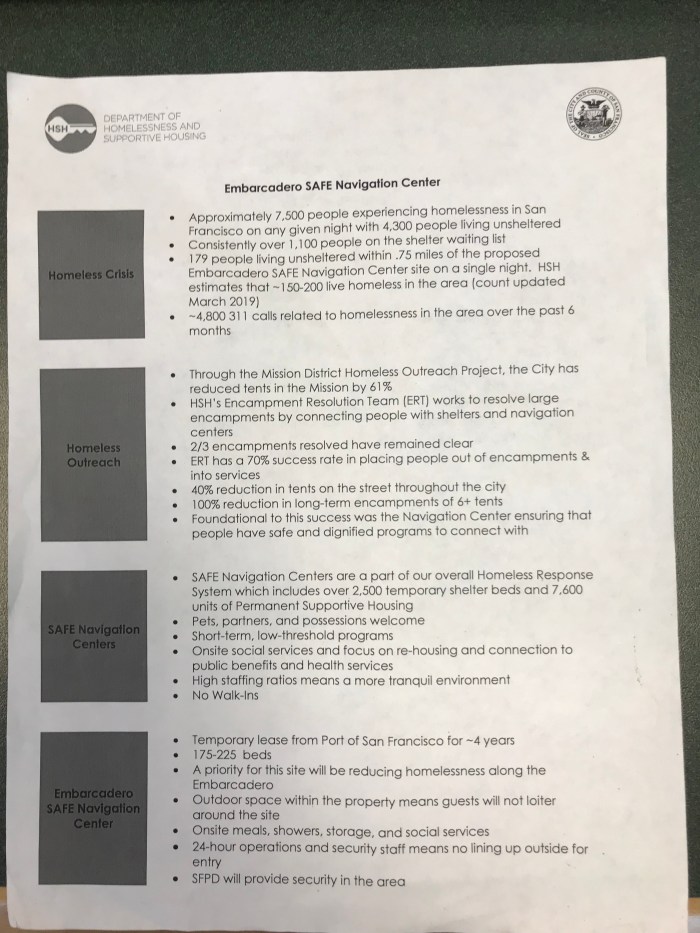
According to DHSH’s presentation as outlined in their handout shown to the left, “approximately 7,493 people are experiencing homelessness in San Francisco. 4,300 people are living unsheltered, over 1,100 people are on the shelter waiting list (DHSH). 179 people are living unsheltered within .75 miles of the proposed SAFE Navigation Center, and lastly about 4,800 311 calls were made related to homelessness in the area over the past 6 months.”
I recorded the meeting from the beginning until the end, which lasted about an hour and a half and edited it into 3 video clips in an effort to show the main points as well as to capture the tension in the auditorium. Even though video clips show small portions of the meeting, undoubtedly, the whole night was characterized by jeering and hostility from the opponents of this new proposal.
Department of Homelessness and Supportive Housing Presentation
DHSH’s presentation, whose main goal was to promise the safety of the future Navigation Center , was unsuccessful in getting favorable response from those who opposed the project. Kaki Marshall, the Director of Shelters and Outreach at DHSH, whom she referred to herself as a former homeless individual, explained how DHSH will ensure neighborhood safety through collaboration with San Francisco Police Department. Marshall also introduced “Good neighbor policy,” in which she described DHSH and SFPD’s effort to maintain constant communication with the neighboring residents to safeguard the area 24/7 . Although not included in the video clip, DHSH also invited the Chief Officer of San Francisco Police Department, David Lazar, to speak about SFPD’s promise to provide the strict surveillance system.
San Francisco Mayor London Breed’s surprise appearance at the community meeting
San Francisco Mayor London Breed was unsuccessful in getting favorable response from residents who opposed the project. The second video clip shows how the community of San Francisco is divided in its opinions on the proposal as San Francisco Mayor London Breed made a surprise appearance at the meeting. Mayor Breed came to explain why she proposed and is supporting the new SAFE Navigation Center. She also welcomed comments and suggestion from the community; however, she was met with a mixture of approval and hostility.
As soon as Mayor Breed stood on the podium, she was faced with cheers and booing. She started by saying, “Do you want me to talk or do you want me down.” The shouting did not stop so she continued, “Either you can let me talk or I can leave.” Later, a man in the crowd shouted, “Go home” and she replied, “I am home. Born and raised in San Francisco.” Despite much booing and many harsh comments that often stopped her from talking, Mayor Breed was successful in maintaining her disposition and continuing her speech.
Mayor Breed’s quote, “I understand that there is a really hard feeling about this particular feeling from both sides. Every single day I am asked what is the city doing to address what we know is the number one crisis in the city,” suggests the complicated nature of the homelessness issue yet Mayor Breed’s determination to come up with the best solution possible.
Towards the end of her speech, Mayor Breed said, “Despite differences, the least we can do is to show respect one another.” This comment especially stood out that night because the meeting was characterized by animosity and lack of civil discourse in the room. The relentless booing did not stop Mayor Breed from leaving the meeting. However, her expression implied that it was not going to be easy for her to appease opponents, who believed that the new Navigation Center should be built somewhere else and not in their affluent neighborhood of Embarcadero.
Q&A Session
DHSH’s Q&A session also was not successful in gaining the support from those who opposed the project. My third clip shows DHSH’s Q&A sessions, in which questions were handwritten during the meeting and submitted by both the supporters and opponents of the proposal. Again, the disunion was striking. Along with the DHSH staff members, the Chief Officer of SFPD, David Lazar, joins the panelist team to answer the questions. I am showing a portion of Q&A sessions.
Kositsky, Director of DHSH, Kaki Marshall, Director of Shelter and Outreach at DHSH, and Rachel Alonso, Project Manager at Public Works
Despite DHSH’s every effort to reiterate the utmost safety in the presentation, a lot of questions were centered on the issue of safety signifying the concern of the residents. Furthermore, these questions conveyed opponents’ stereotypical perspective that homeless individuals are threats and instigators of crime instead of victims.
- 1) “If the police are slow to respond due to short staffing or gridlock, what will change?” (video clip 3:08)
- 2) “How are you going to ensure residents of the Navigation Center are not doing drugs ” (3:58)
- 2)”I’m a mom. How will my son be safe playing next to the Navigation Center?” (4:59 )
- 3) How many homeless in SF are drug addicts and what are the resources available to keep them clean and public safe?” (7:50)
- 4) “How will the neighborhood safety be assured if drug users must leave to do drugs outside the building?” (9:01)
To these safety concerning questions, Jeff Kositsky, the Director of DHSH and David Lazar, the chief officer of SFPD steadfastly reassured that homeless people at the Navigation Center are not drug users and that there will be police patrols of the designated area 4 times a day with security connected directly to SFPD with 311 calls available 24/7.
Other question such as , ” How much does it cost for the city not to shelter a person?” (2:02) was unrealistic and missing the point. Another question “Why is it important to have a safe place for people to sleep?” (6:16) seemed to be lacking in common sense. To these questions, one cannot help but notice shocked cries from the supporting crowed.
Toward the end of the Q&A session, the video clip shows opponents standing up from their seats angrily. The clip also shows a fight, which broke out between supporters and opponents of the new project.
Concluding Analysis
Lastly, this meeting emphasized the public safety surrounding the new Navigation Center. However, what stood out was the relentless booing and jeering of the opponents throughout the night despite the moderator’s request for the crowd to keep silence and show respect. In addition, as a stark contrast, whenever a person taunted at DHSH staff or London Breed, one cannot help but notice supporters of the project quietly hold up bright pink and green signs that said, “Hate has no home” and “Yes in my SF.” As a spectator simply observing the scene, the supporters’ silence and peaceful manner seemed more effective in attracting potential supporters to support the project. On the other hand, the opponents of this project may have undermined their image and support for their position through their conduct at the meeting. The final meeting will be on April 23rd at 2:30 pm at Pier 1 where the Port Commission will vote on whether or not to approve this project If the project is approved, the new SAFE Embarcadero Navigation Center will open in Summer of 2019.
Video Clips
Credits in video clips: San Francisco Mayor London Breed, David Lazar, Chief Officer of San Francisco Police Department, Jeff Kositsky, Director of DHSH, Kaki Marshall, Director of Shelter and Outreach at DHSH, and Rachel Alonso, Project Manager at Public Works
Okawa, Saori. “Department of Homelessness and Supportive Housing Community Meeting.” YouTube, 11 April 2019. https://www.youtube.com/watch?v=R-FlEtye6uI&t=4s
Okawa, Saori. “SF Mayor Breed’s Surprise Visit: Community Meeting for the new SAFE Embarcadero Navigation Center.” YouTube, 9 April 2019. https://www.youtube.com/watch?v=XzUnI8sxXEY
Okawa, Saori. “Q&A Session at DHSH Community Meeting for SAFE Embarcadero Center.” YouTube, 11 April 2019. https://www.youtube.com/watch?v=sKmdU3iwjeM&t=5s.

 The Homeless Crisis: Can Tech Companies Help San Francisco?
Thank you for posting the video. As a resident of San Francisco I can see how big is the problem regarding homelessness is. Will be interesting what they will decide, hopefully they will approve the project.
LikeLike
I feel like all we do as a bay area society is talk about the homelessness situation and continuously just bounce around ideas until its time for the next official to take office meanwhile the money thats supposed to fix the situation goes into the pockets of our city officials. It’s time we/ city officials start to act on this issue more effictively.
LikeLike
Incredible work examining the Nav Center! This has been SUCH a hot button issue since long before it opened and I imagine it will continue to be one for a long time, regardless of the function or capacity it serves. Really, I think it does more to highlight our own inability to get anything done.
LikeLike
I like the video that you make. Homeless is a big issue in the San Francisco because people cannot afford the housing in the San Francisco. This makes this issue worst than we thought.
LikeLike