City Hall, Room 200 1 Dr. Carlton B. Goodlett Place San Francisco, CA 94102
Re: Letter of Request
Honorable Mayor London Breed,
My name is Saori Okawa,
and I am a student at City College of San Francisco who intends to pursue a
career in social work and clinical counseling. I firmly believe that you have
brought many positive changes to the problems on homelessness, such as building
Navigation Centers, (with the newest one coming in Embarcadero this summer), adding
beds to facilities, and expediting the process of unfreezing funds that will
derive from the Homelessness Tax (formerly Proposition C). However, I implore you to reconsider the
implementation of Senate Bill 1045.
While Senate Bill 1045
is an expansion of the current conservatorship bill, “Laura’s Law,”
which aims to protect homeless individuals with both mental illness and
substance abuse, the bill does not address the root of the problem. San
Francisco’s mental health care system is still inept to adequately house and
provide wraparound medical services to the individuals that will be conserved
under this bill. Approximately 1,000 people are currently on waitlists for
shelters, navigation centers including the behavioral health navigation center,
Hummingbird Place), transitional homes and respite care centers. Senate Bill
1045 will place conserved individuals ahead of everybody, and push back all the
others who have been waiting voluntarily on the waitlists for a long time.
Senate Bill 1045 is of grave
concern because it can be construed as taking away the civil rights of the
conserved individuals. The bill is not an exemplary solution to addressing the
mental health crisis on the streets because there is still no guarantee that
sound, safe services such as protective housing and mental health support will
be available.
Thank you very much for taking time to read my letter. I have built an academic website on the homeless crisis in San Francisco, which reflects my research on this issue (http://homelesscrisisinsfcompanies.tech.blog). I would greatly appreciate your reconsidering of the implementation of Senate Bill 1045.
Mental illness and homelessness are
deeply embedded in America. The connection between the two is complicated and has
reciprocal effects on each other; that is, a person is likely to end up being
homeless if his mental ability to carry out everyday lives becomes difficult,
and if a person is homeless, he is likely to develop mental illness because of
severe living conditions on the streets.
A Brief History of Homelessness in the United States
Homelessness in the United States has its roots in the late 19th and early 20th centuries when mass migration was common for workers. Teresa Gowan, the author of Hobos, Hustlers, and Backsliders: Homeless in San Francisco, explains that impoverished workers who lived on the roads and railways (without homes) became the first to be known as society’s homeless (3). Gowan further claims the country saw a spike in homelessness during the Ronald Reagan administration’s deinstitutionalization, or closure of state mental health hospitals. Along with Reagan’s social welfare rollback, deinstitutionalization led to discharge of thousands of mentally ill patients out in the community. While this movement was to stop involuntary hospitalization, cities all over America lacked funds to offer psychiatric services and often times, many mentally ill patients ended on the streets or in jails (4-6).
The
Mental Health Crisis in California and San Francisco Today
In California, it is almost impossible to address the homeless crisis without acknowledging the mental health crisis. Phillip Reese wrote in “California Hospitals See Massive Surge in Homeless Patients” in Kaiser Health News, that more than 1/3 of 100,000 homeless patient visits to California hospitals in 2017, comprised of individuals with mental illness. Reese named San Francisco as one of the top counties that had the highest proportion of discharges involving homeless patients with mental health diagnosis. Erin Allday, a health care journalist who wrote a San Francisco Chronicle, “The Street’s Sickest, Costliest: The Mentally Ill,” also reported that 1/3 or more homeless in San Francisco are mentally ill who suffer mostly from post-traumatic stress, schizophrenia and bipolar disorder. Allday said mental health is “the most stubborn obstacle to San Francisco’s homelessness,” and called for a need for a reform in the mental health care system to stop the vicious cycle of streets, emergency rooms and jails.
What
is Wrong with Mental Health Care System for Homeless People in San Francisco
In San Francisco, the mental health crisis is also visible on the streets and there is a clear need for a better mental health care system. In a San Francisco Chronicle article, “Fixing San Francisco’s Behavioral Health System is Complicated-Here’s Why,” Trish Thadani, a City Hall reporter, reported that the City spends about nearly $400 million on behavioral health services and 300 programs yet there seems to be unrelenting numbers of mentally distressed homeless people who have nowhere to go. Thadani named city’s mental health care system, a “tangled web of complex and expensive services,” which finally led Mayor Breed to appoint the city’s first Director of Mental Health Reform on March 27, 2019 (Thadani).
90 % of 44,809 clients accessing psychiatric emergencies in 2016-2017 often have dualmental health and substance abuse disorders and experience homeless
Nearly 40 % of 6,704 homeless people discharged from psychiatric emergency rooms were not contacted with follow up medical services in 2017. Linking them to services on discharge is important so they don’t “decompensating mentally, but of also resorting to alcohol and substance abuse after being discharged.”
There is shortage of intensive care managers who are responsible for keeping clients engage in treatment and transition into community- “demand exceeds supply”
There is a “constant presence of waitlists and wait times” for clients with substance use disorder. The average wait time is 5-21 days for residential non-methadone treatment and 1.3-66 days for outpatient non-methadone treatment in 2016.
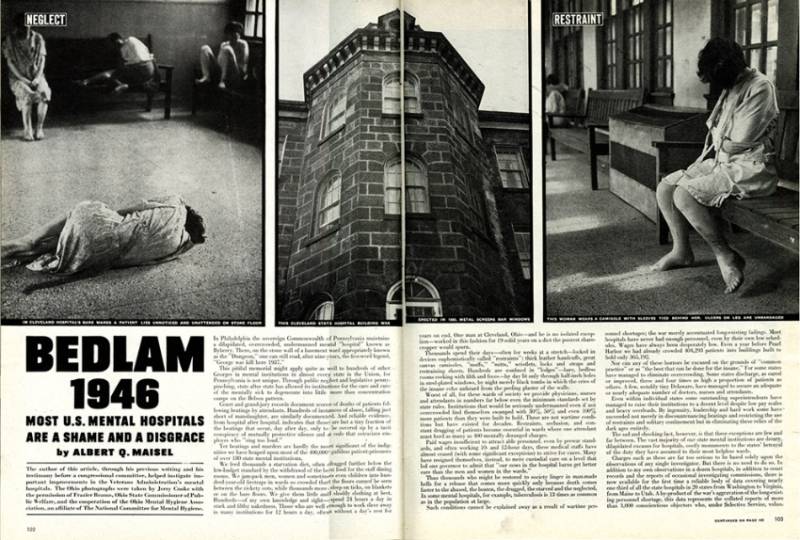
Along with these findings, the city lacks beds in many facilities. Heather Knight, a columnist writing out of City Hall and the author of the San Francisco Chronicle, “A Glimmer of Hope for Mental Health Services in SF,” reported that there are too few beds in every level of care from emergency rooms, acute care to long term facilities. She also disclosed that psychiatric emergency room at SF General Hospital also has 18 beds yet there were 26 patients crammed in every corner of the facility on one Monday morning in 2019, and doctors often have to turn patients back quickly to the streets because of lack of long term care facilities.
The
city also suffers from lack of interim places between psychiatric emergency and
the streets such as transitional homes. Nuala Sawyer, the author and the news
editor of San Francisco Weekly who wrote “Mental
Health, Homelessness and Civil Rights: S.F.’s Crisis of Conscience,” stated
that “all the shelters, transitional homes are always full,” and Hummingbird
Place, San Francisco’s only behavioral health navigation center has 29 beds and
they are constantly full.
It is apparent that homeless individuals
frequent psychiatric emergencies the most but there is a clear lack of resources
to support them despite the city’s spending on behavioral health services. If
there are not enough beds in facilities, homeless individuals with mental
disorder are likely to return to the streets without proper treatment. If these
homeless individuals do not receive follow up services after their discharge
due to lack or resources, there is a high chance that they will be back on the streets
while their conditions worsen. These findings all signify that the homeless
crisis in San Francisco is not solely about lack of affordable housing. Lack of
an organized system in the mental health care services, as well as resources add
complexity to the homeless population who are mentally distressed.
Mayor
Breed’s solution to the mental health crisis on the streets
In an effort to address such mental
and homeless crisis, San Francisco Mayor London Breed came forward with a proposition. In her Medium Blog post “280
New Navigation Center Beds and Continuing our Progress on Homelessness,”
Mayor Breed proposed a solution to alleviating the mental health crisis – to-
implement Senate Bill 1045 (SB 1045). Senate Scott Wiener authored SB 1045 and it
grants an authority to San Diego, San Francisco and Los Angeles to “conserve” those
who are suffering from mental illness and drug addiction in 5 year pilot
program (Lipscomb). The term “conserve” takes the meaning of
“institutionalization” where an individual is locked up in psychiatric
facilities (Sawyer). California Governor Jerry Brown signed SB 1045 in
September 2018, and each county can decide whether to implement the bill as
long as each county can provide evidence that it has enough housing and medical
services to those who are conserved (Sawyer). In San Francisco, a hearing is scheduled on May
14, 2019 at the Senate Appropriations Committee before the Board of Supervisors
of San Francisco can implement this bill (Sawyer).
However, there is much controversy among civil rights group and people who claim that SB 1045 is not an effective solution to the underlying problem of homelessness because there is clearly a lack of mental health systems and NOT a lack of authority to detain those with mental illness. Instead of implementing Senate Bill 1045, Mayor Breed must alleviate San Francisco’s homeless crisis by reorganizing and increasing resources to improve the existing mental health care system.
Works Cited
Gowan, Teresa. Hobos, Hustlers, and Backsliders: Homeless in San Francisco. University of Minnesota Press, 2010.
Those in favor of SB 1045 believe that the bill is an effective way to address the mental health crisis on the streets; however, without substantial data to support the city’s capability to provide supportive housing and medical services mandated by the bill. Senator Scott Wiener believes that current conservatorship laws, Lanterman Petris Short (LPS) Conservatorship and Assisted Outpatient Treatment ( Laura’s Law) are not adequate in addressing the mental health crisis on the streets. In “Senators Wiener and Stern Announce Bill to Expand Conservatorship to Help Mentally Ill and Drug Addicted People Dying on California’s Street,” the California State Senate quoted Wiener, “California is in the midst of a crisis, with very sick people suffering and dying on our streets… We must take action, and action means helping people get off the streets, into housing and into supportive services to get their lives back.” Wiener believes that the city is doing a humanitarian job by dispatching city officials to intervene with the mentally ill on the streets city, and he surmised that the bill is the most effective solution and a big step in addressing homelessness.
Mayor Breed also believes that SB 1045 will provide a solution that the city much needs. She expressed her concern in her Medium blog post that too many people are suffering from “severe behavioral health and substance use issues” on the streets of San Francisco who end up in hospitals and criminal justice system. Mayor Breed expressed:
It is
not humane to allow people with severe mental health and addiction issues to
continue to suffer on our streets. This bill would give San Francisco the
ability to help individuals who are incapable of caring for themselves, while
providing the wraparound services they need to get their lives back on track.
Mayor Breed believes that
implementing SB 1045 will make drastic improvements in the mental health crisis;
however, she still fails to mention the current waitlists for housing, residential
and outpatient substance treatment and transitional homes for homeless people
in the city.
Rafael Mandelman also shows his support for SB 1045. Mandelman is the District 8 member of San Francisco Board of Supervisors in California who is in charge of developing the plan for SB 1045. His mother also suffered from from bipolar disorder, schizoaffective disorder and borderline personality (Sawyer). Mandelman frequently saw people running around on streets naked and howling, and began to believe that there needs to be an increase in the city’s use of “conservatorship” to get people into care (Sawyer). Mandelman also believes that SB 1045 will help those who are “cycling in and out of medical system multiple times a year should be held for an extended period, to sober up get on medication, and get back on their feet” (Sawyer). However, Mandelman fails to explain how the city can offer facilities where conservesd individuals feel safe to receive mental health care.
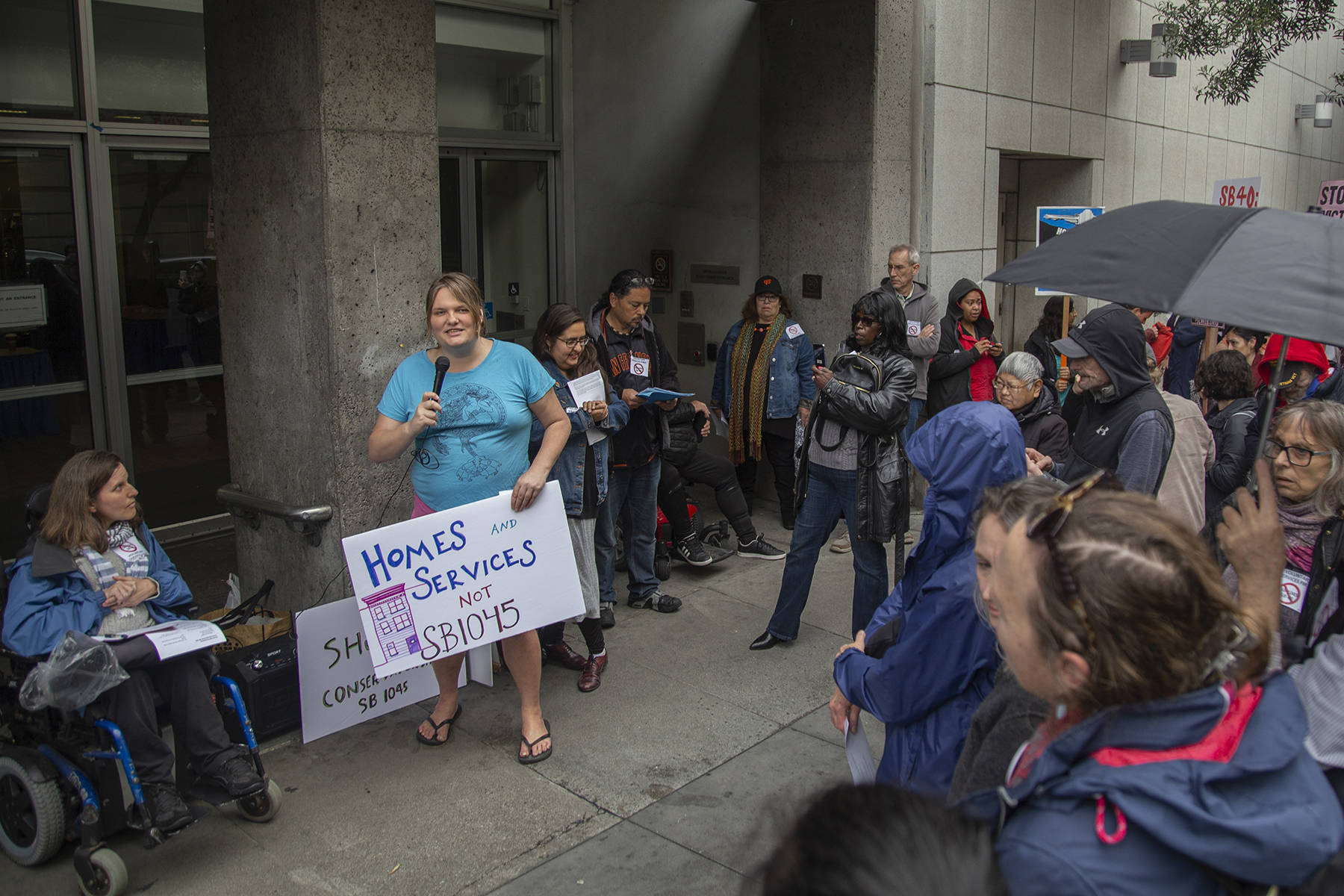
Those who oppose SB 1045 are mainly focused on protecting civil rights of homeless people targeted in the bill and showed skepticism because of the city’s lack of adequate resources. Voluntary Services First Coalition (VSFC), lead by Jennifer Friedenbach, the executive director of Coalition on Homelessness San Francisco, is comprised of 12 homeless advocates groups such as Disability Rights California, Disability Rights Advocates, Coalition on Homelessness San Francisco, American Civil Liberties Union and others (Sawyer).
SB 1045 can violate civil rights
First, VSFC expressed that there should be an enhanced mental health care system to help those suffering from mental illness and substance use disorder instead of taking away their civil rights (Sawyer). VSFC believes that California’s current law, “Laura’s Law,” already detains people with serious mental illness who are unable to take care of himself and there is no need for an expansion. Further expanding this conservatorship law can interfere with individual’s civil rights. In their letter “RE: SB 1045 (WIENER) (amended May 1, 2018) – OPPOSE “ addressed to Senator Ricardo Lara of California State Senate, VSFC wrote that SB 1045 will “restrict the personal autonomy rights of persons with disabilities and it lacks any assurance of housing and services.”
Those
who believe in protecting civil rights believe that SB 1045 can produce trauma associated
with involuntarily hospitalization. Erik Henriques, a Peer Provider Manager for
Mental Health Association of San Francisco, a “90 % peer-run organization”
comprised of individuals who underwent mental illness at first hand, published
an article, “Survivors
of Forced Treatment: Erik.” Henriques criticized SB 1045 because it “provokes
painful memories of a time when people with mental health challenges were
warehoused in state hospitals for years at a time against their will with no
true mental health support.” Henriques was conserved at state hospitals in the
80s and this trauma like experience led him to oppose SB 1045.
SB 2015 will not address lack of resources in the mental health care system
VSFC also emphasized city’s lack of resources to help those mentally ill and believes providing them should be the priority of San Francisco. VSFC observed lack of subsidized housing, and quality mental health support system by mentioning long waitlists in both fields, and believe that SB 1045 will not offer the solutions to these demands. VSFC quoted, “Nothing in this (SB 1045) expands housing or access to medical and behavioral health services for individuals who are homeless and have behavioral and medical health treatment needs.” In “SB 1045: Conservatorship A Faulty Approach to the Homeless Crisis,” Jessica Lehman at Senior and Disability Action showed skepticism because SB 1045 would be built on the “false narrative” that homeless people with mental illness choose not to get help when in fact, there are not enough medical services available for them. Lehman also pointed out that implementation of the bill can take away housing or services from anyone who is seeking them voluntarily and in the waitlist, and as long as there are waitlists for these services, the city should not implement SB 1045.
With clear divisions on the issue of SB
1045, Mayor Breed must focus on providing additional facilities and health care
systems for people with mental illness living on the streets. Performance
Audit of the Department of Public Health Behavioral Health Services in April
2019
proves that the city lacks resources in the mental health care system. SB 1045
on the other hand will require the city to divert resources to increase
policing of homeless individuals. San
Francisco’s mental health care system is gravely impacted already. Unless the
city organizes and restructures the current system, the city needs to
reconsider implementing SB 1045.
SB 1045 will reinforce the vicious cycle of police authority to detain homeless people
SB 1045 will only reinforce vicious cycles of streets, psychiatric emergency rooms, and jails. In Street Sheet ‘s “Expanded Conservatorships: The New Trauma Detentions,” Jessica Friedenbach explained that psychiatric emergency services typically release a homeless person under 5150 hold back to the streets quickly for a lack of community resources. Friedenbach claimed that once an individual returns to streets without proper housing or treatment, his conditions persist or worsen, and most likely he will be detained again under 5150, and this time he can be put into jail.
SB 1045 does not promise secured housing and health services
SB 1045 also fails to promise secured housing and wraparound services for conserved individuals. Currently, there is a continuous need for more beds in medical facilities and long waitlists for services and supportive housing. An individual should not have to be gravely mentally disabled in order to get housing and medical services. People who have been waiting for a long time to get medical services and housing should not be pushed back because the city decides to put conserved individuals first in the waitlists.
The City has not been spending the budget wisely
In addition, there is no need to implement SB 1045 if the city uses funds wisely to renovate the current mental health care system. The funds that would be discussed in regard to SB 1045 at the hearing at the Senate Appropriations Committee on May 14th should instead be allocated to acquiring more beds and resources within mental health services. Implementing SB 1045 will require extra police effort, which means extra funds for dispatching the police force, which is unnecessary use of their time and the budget. In Street Sheet’s “CA Threatens to Turn Back the Clock on Mental Health Care,” a contributor, Alex Bernard mentioned current conservatorship law faces “insufficient funds” as the city has ran out of places to put conserved clients.
Instead of expanding the current law to detain those with mental illness, the city must use funds wisely to create more facilities and safe places for them to stay. In San Francisco Chronicle’s “The Street’s Sickest, Costliest: The Mentally Ill,” Jacob Kaminker, PhD in Psychology and the head of the Psychological Association, also questioned the city’s priority, “Are we going to offer better services to these people? (homeless individuals) or are we going to spend that money on law enforcement…?” The underlying issue is not that there is lack of policing of individuals with mental illness, and the city needs to stop spending unnecessary money on law enforcement of homeless individuals. The real issue is that there needs to be a safe place for homeless individuals with mental illness to stay where they can have an uninterrupted medical support system.
To alleviate the homeless crisis that is deeply affected by the mental health crisis, Mayor Breed must provide a fully supported system of mental health care within a safe place. First, San Francisco residents should credit Mayor Breed for appointing Dr. Anton Bland as the city’s very first Director of Mental Health Reform in March of this year because this will be the first step in reorganizing and assessing what is not working in the current mental health care system. Dr. Bland is currently the Medical Director at Psychiatric Emergency Services at San Francisco General Hospital, and Mayor Breed needs to work closely with him to avoid the city’s past irresponsible spending in behavioral health services. Careful review of the current system will cut costs and reallocate funds to the most needed sectors of the mental health care.
Mayor Breed needs to acquire funds from the Homelessness Tax (formerly known as Proposition C), which passed in November of 2018 to strengthen the mental healthcare system. This taxation will bring about $200-300 million annually for homelessness (Fracassa). According to SF Positive Resource Center (PRC)’s website, a nonprofit organization authorized by the city that helps individuals with mental health, substance abuse and HIV issues that operates 6 facilities that offer residential treatment programs for mental health programs, most of transitional homes have 11-16 beds, and they are full. Mayor Breed should use the funds to increase beds and hire more workers. Behavioral health departments, psychiatric emergency rooms, transitional homes and residential treatment homes constantly need intensive case management workers, social workers and nurses. Hiring more workers could mean each homeless individual will have a designated worker that will see them through the treatment. In addition, adequate staffing enables facilities to operate longer hours and allow homeless people to drop in any time of day or night.
In addition, Mayor Breed needs to create more facilities like Hummingbird Place, which acts as interim between psychiatric emergencies and the streets where homeless people can stay after they are being discharged from psychiatric emergency rooms. Hummingbird Place is the city’s only “behavioral health navigation center” among 6 others. This behavioral navigation center is located within San Francisco General Hospital Campus (run by PRC) where clients who are discharged from psychiatric emergency rooms can stay and receive intensive care treatment. The average stay for a client is 14 days and the facility is always full. In San Francisco Chronicle article written by Dominic Fracassa, “Navigation Center is a Respite from the Streets for Mentally Ill, Addicted,” Kelly Hiramoto, the director of SF Health Network’s Transitions with Department of Public Health, commented that Hummingbird Place uses a “low-pressure” approach (non-aggressive manner) to the clients to educate that there are options other than going back to the streets (Fracassa).
Mayor Breed needs to build more facilities like Hummingbird Place. Currently, Hummingbird Place has maintained a successful record of having nearly 1 out of 2 people accessing the Hummingbird Place exit to take another step out of homelessness at the end of 2018 (Fracassa). The successful record from Hummingbird Place confirms that transitional homes are necessary because individuals can have interrupted medical services within the safe environment and individuals receive support for transitioning out of the streets.
There
is no simple solution to the homeless crisis. First and foremost, along with
housing, Mayor Breed must facilitate these changes in the mental health care
system so that there will finally be a significant dent in the homeless crisis.
Once Mayor Breed continues to make positive changes, she will influence the
community of San Francisco to participate in alleviating this crisis. The
change also has to come from the community where there is a stigma towards homeless
people because are victims of social inequality and not instigators of crime.
A controversy and division among San Francisco residents between those who see homelessness as moral imperatives to help or homelessness as a threat in the neighborhood
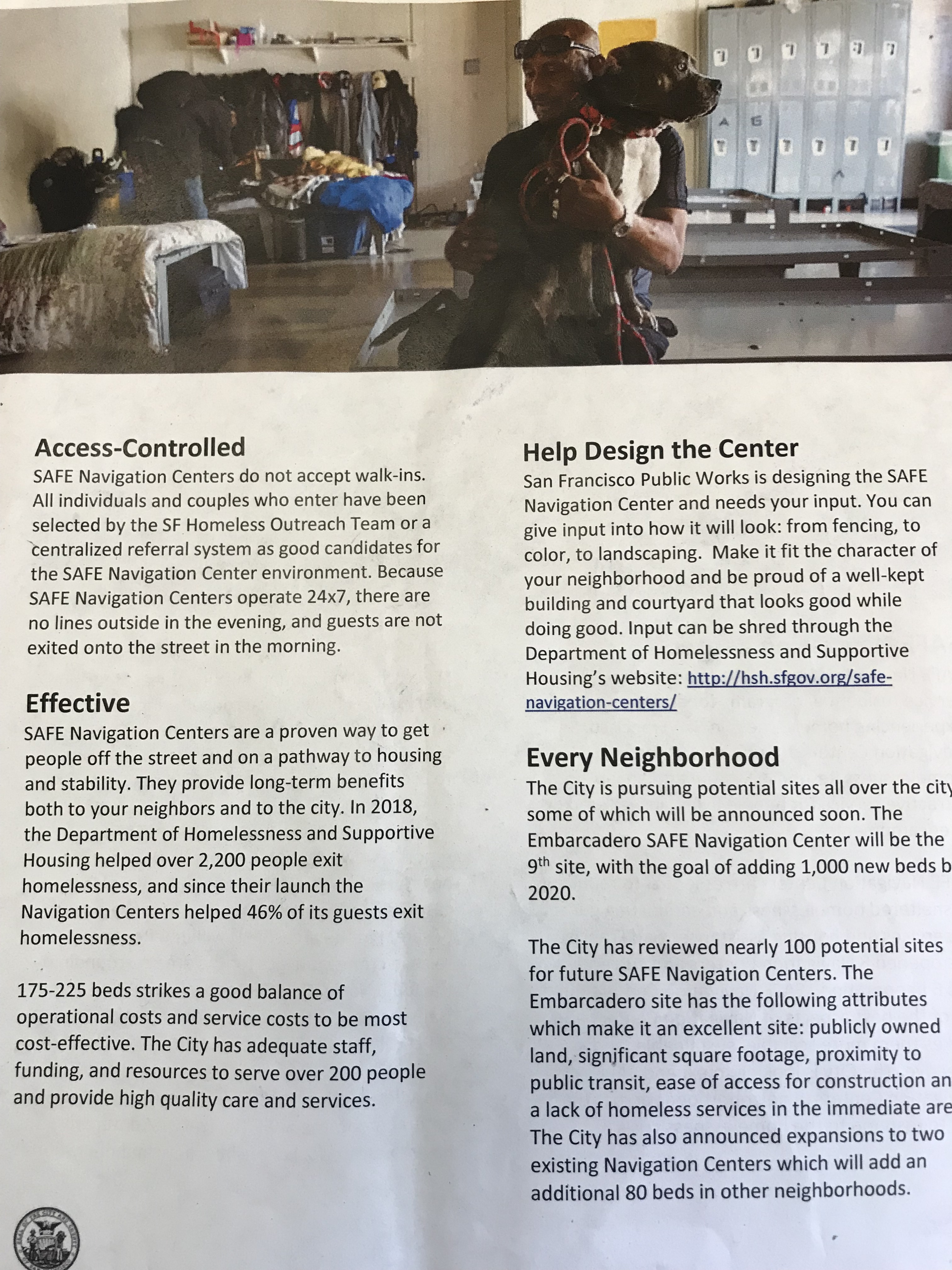
On April 3, 2019 at 6 p.m, San Francisco’s Department of Homelessness and Supportive Housing (DHSH) held a community meeting to introduce the opening of the new “Embarcadero SAFE Navigation Center,” which is to be built in Summer of 2019.
The new proposal and this meeting aroused a lot of controversy and division among San Francisco community between those who see solving homelessness as moral imperatives of residents and those who see homelessness as potential risk to safety in their neighborhood. The meeting was held at Delancy Street Foundation at 600 Embarcadero, and the room was packed to its capacity of 200 people with the city workers, armed police officers, camera and news crews, supporters of the project, and residents of surrounding South Beach condominiums, most of whom oppose the plan. DHSH found Seawall Lot 330 in Embarcadero to be an ideal property for the city’s largest 200-bed Navigation Center, which will address the current homeless crisis.
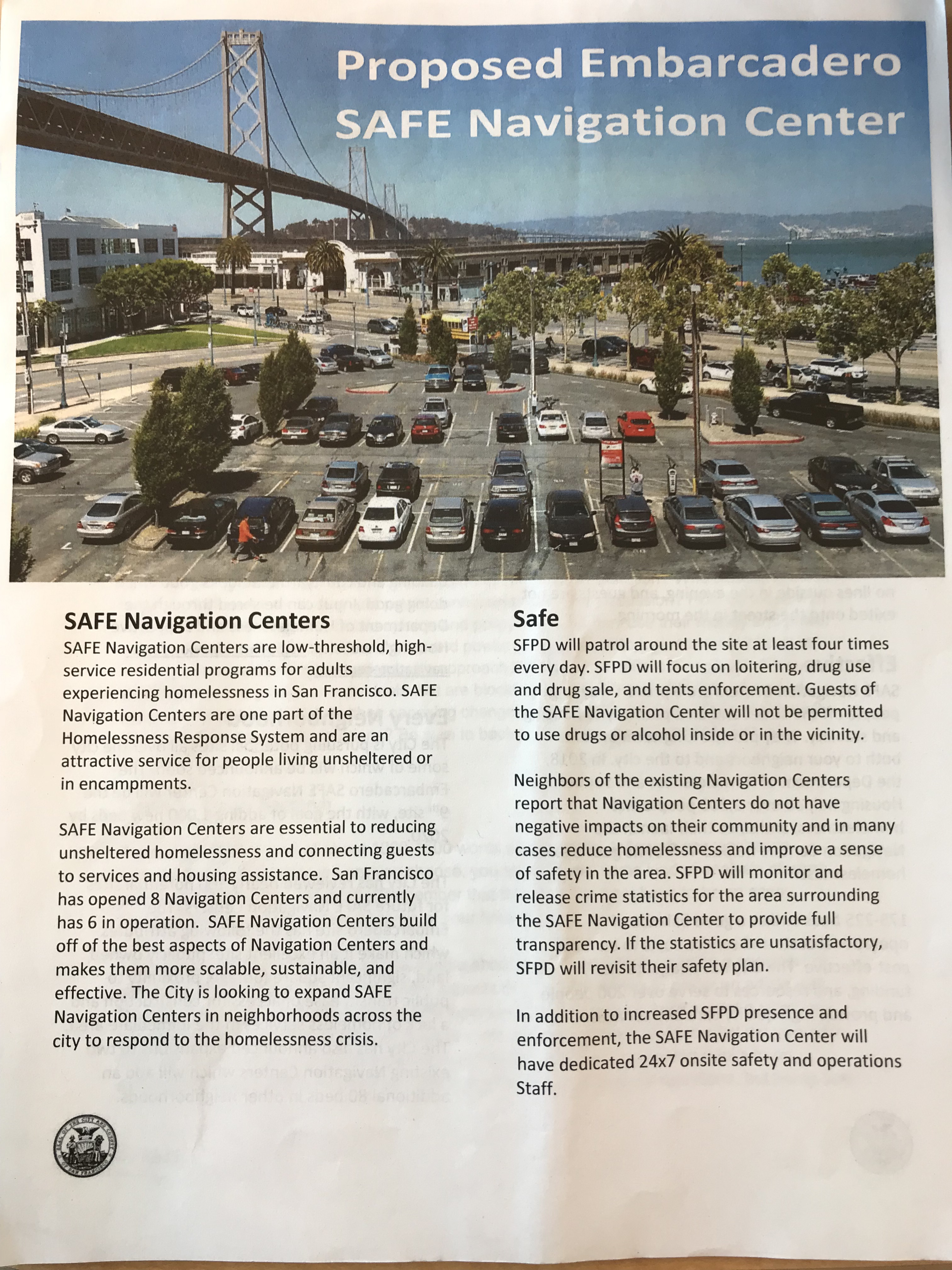
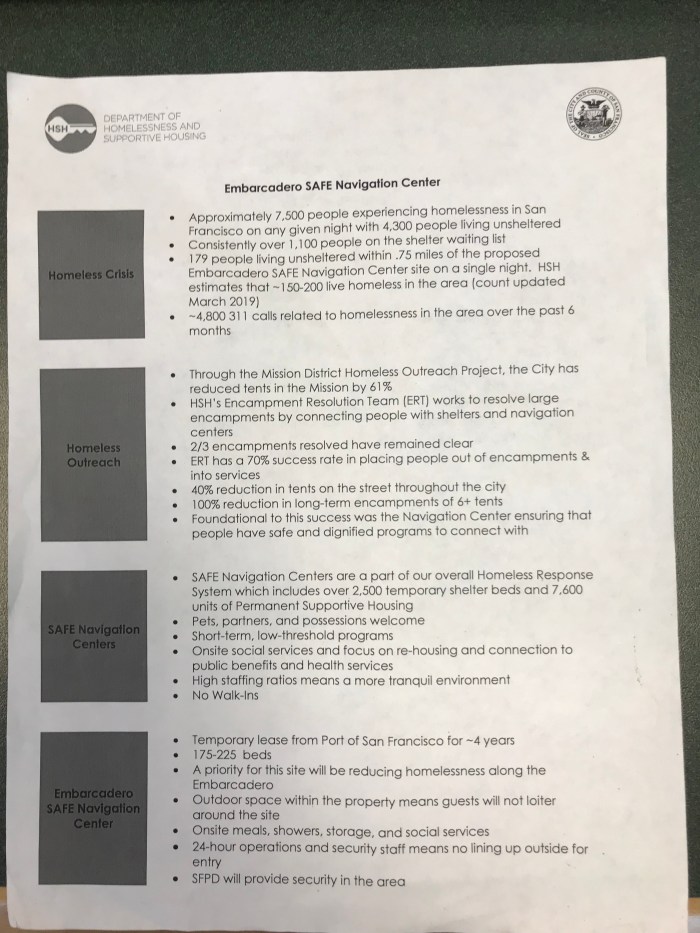
DHSH handout at the meeting
According to DHSH’s presentation as outlined in their handout shown to the left, “approximately 7,493 people are experiencing homelessness in San Francisco. 4,300 people are living unsheltered, over 1,100 people are on the shelter waiting list (DHSH). 179 people are living unsheltered within .75 miles of the proposed SAFE Navigation Center, and lastly about 4,800 311 calls were made related to homelessness in the area over the past 6 months.”
I recorded the meeting from the beginning until the end, which lasted about an hour and a half and edited it into 3 video clips in an effort to show the main points as well as to capture the tension in the auditorium. Even though video clips show small portions of the meeting, undoubtedly, the whole night was characterized by jeering and hostility from the opponents of this new proposal.
Department of Homelessness and Supportive Housing Presentation
DHSH’s presentation, whose main goal was to promise the safety of the future Navigation Center , was unsuccessful in getting favorable response from those who opposed the project. Kaki Marshall, the Director of Shelters and Outreach at DHSH, whom she referred to herself as a former homeless individual, explained how DHSH will ensure neighborhood safety through collaboration with San Francisco Police Department. Marshall also introduced “Good neighbor policy,” in which she described DHSH and SFPD’s effort to maintain constant communication with the neighboring residents to safeguard the area 24/7 . Although not included in the video clip, DHSH also invited the Chief Officer of San Francisco Police Department, David Lazar, to speak about SFPD’s promise to provide the strict surveillance system.
Kaki Marshall, the Director of Shelter and Outreach at DHSH
San Francisco Mayor London Breed’s surprise appearance at the community meeting
San Francisco Mayor London Breed was unsuccessful in getting favorable response from residents who opposed the project. The second video clip shows how the community of San Francisco is divided in its opinions on the proposal as San Francisco Mayor London Breed made a surprise appearance at the meeting. Mayor Breed came to explain why she proposed and is supporting the new SAFE Navigation Center. She also welcomed comments and suggestion from the community; however, she was met with a mixture of approval and hostility.
San Francisco Mayor London Breed at the podium
As soon as Mayor Breed stood on the podium, she was faced with cheers and booing. She started by saying, “Do you want me to talk or do you want me down.” The shouting did not stop so she continued, “Either you can let me talk or I can leave.” Later, a man in the crowd shouted, “Go home” and she replied, “I am home. Born and raised in San Francisco.” Despite much booing and many harsh comments that often stopped her from talking, Mayor Breed was successful in maintaining her disposition and continuing her speech.
Mayor Breed’s quote, “I understand that there is a really hard feeling about this particular feeling from both sides. Every single day I am asked what is the city doing to address what we know is the number one crisis in the city,” suggests the complicated nature of the homelessness issue yet Mayor Breed’s determination to come up with the best solution possible.
Towards the end of her speech, Mayor Breed said, “Despite differences, the least we can do is to show respect one another.” This comment especially stood out that night because the meeting was characterized by animosity and lack of civil discourse in the room. The relentless booing did not stop Mayor Breed from leaving the meeting. However, her expression implied that it was not going to be easy for her to appease opponents, who believed that the new Navigation Center should be built somewhere else and not in their affluent neighborhood of Embarcadero.
Q&A Session
DHSH’s Q&A session also was not successful in gaining the support from those who opposed the project. My third clip shows DHSH’s Q&A sessions, in which questions were handwritten during the meeting and submitted by both the supporters and opponents of the proposal. Again, the disunion was striking. Along with the DHSH staff members, the Chief Officer of SFPD, David Lazar, joins the panelist team to answer the questions. I am showing a portion of Q&A sessions.
Panelists from left to right: David Lazar, Chief Officer of SFPD, Jeff Kositsky, Director of DHSH, Kaki Marshall, Director of Shelter and Outreach at DHSH, and Rachel Alonso, Project Manager at Public Works
Despite DHSH’s every effort to reiterate the utmost safety in the presentation, a lot of questions were centered on the issue of safety signifying the concern of the residents. Furthermore, these questions conveyed opponents’ stereotypical perspective that homeless individuals are threats and instigators of crime instead of victims.
1) “If the police are slow to respond due to short staffing or gridlock, what will change?” (video clip 3:08)
2) “How are you going to ensure residents of the Navigation Center are not doing drugs ” (3:58)
2)”I’m a mom. How will my son be safe playing next to the Navigation Center?” (4:59 )
3) How many homeless in SF are drug addicts and what are the resources available to keep them clean and public safe?” (7:50)
4) “How will the neighborhood safety be assured if drug users must leave to do drugs outside the building?” (9:01)
To these safety concerning questions, Jeff Kositsky, the Director of DHSH and David Lazar, the chief officer of SFPD steadfastly reassured that homeless people at the Navigation Center are not drug users and that there will be police patrols of the designated area 4 times a day with security connected directly to SFPD with 311 calls available 24/7.
Other question such as , ” How much does it cost for the city not to shelter a person?” (2:02) was unrealistic and missing the point. Another question “Why is it important to have a safe place for people to sleep?” (6:16) seemed to be lacking in common sense. To these questions, one cannot help but notice shocked cries from the supporting crowed.
Toward the end of the Q&A session, the video clip shows opponents standing up from their seats angrily. The clip also shows a fight, which broke out between supporters and opponents of the new project.
Concluding Analysis
Lastly, this meeting emphasized the public safety surrounding the new Navigation Center. However, what stood out was the relentless booing and jeering of the opponents throughout the night despite the moderator’s request for the crowd to keep silence and show respect. In addition, as a stark contrast, whenever a person taunted at DHSH staff or London Breed, one cannot help but notice supporters of the project quietly hold up bright pink and green signs that said, “Hate has no home” and “Yes in my SF.” As a spectator simply observing the scene, the supporters’ silence and peaceful manner seemed more effective in attracting potential supporters to support the project. On the other hand, the opponents of this project may have undermined their image and support for their position through their conduct at the meeting. The final meeting will be on April 23rd at 2:30 pm at Pier 1 where the Port Commission will vote on whether or not to approve this project If the project is approved, the new SAFE Embarcadero Navigation Center will open in Summer of 2019.
Video Clips
Credits in video clips: San Francisco Mayor London Breed, David Lazar, Chief Officer of San Francisco Police Department, Jeff Kositsky, Director of DHSH, Kaki Marshall, Director of Shelter and Outreach at DHSH, and Rachel Alonso, Project Manager at Public Works
Okawa, Saori. “SF Mayor Breed’s Surprise Visit: Community Meeting for the new SAFE Embarcadero Navigation Center.” YouTube, 9 April 2019. https://www.youtube.com/watch?v=XzUnI8sxXEY
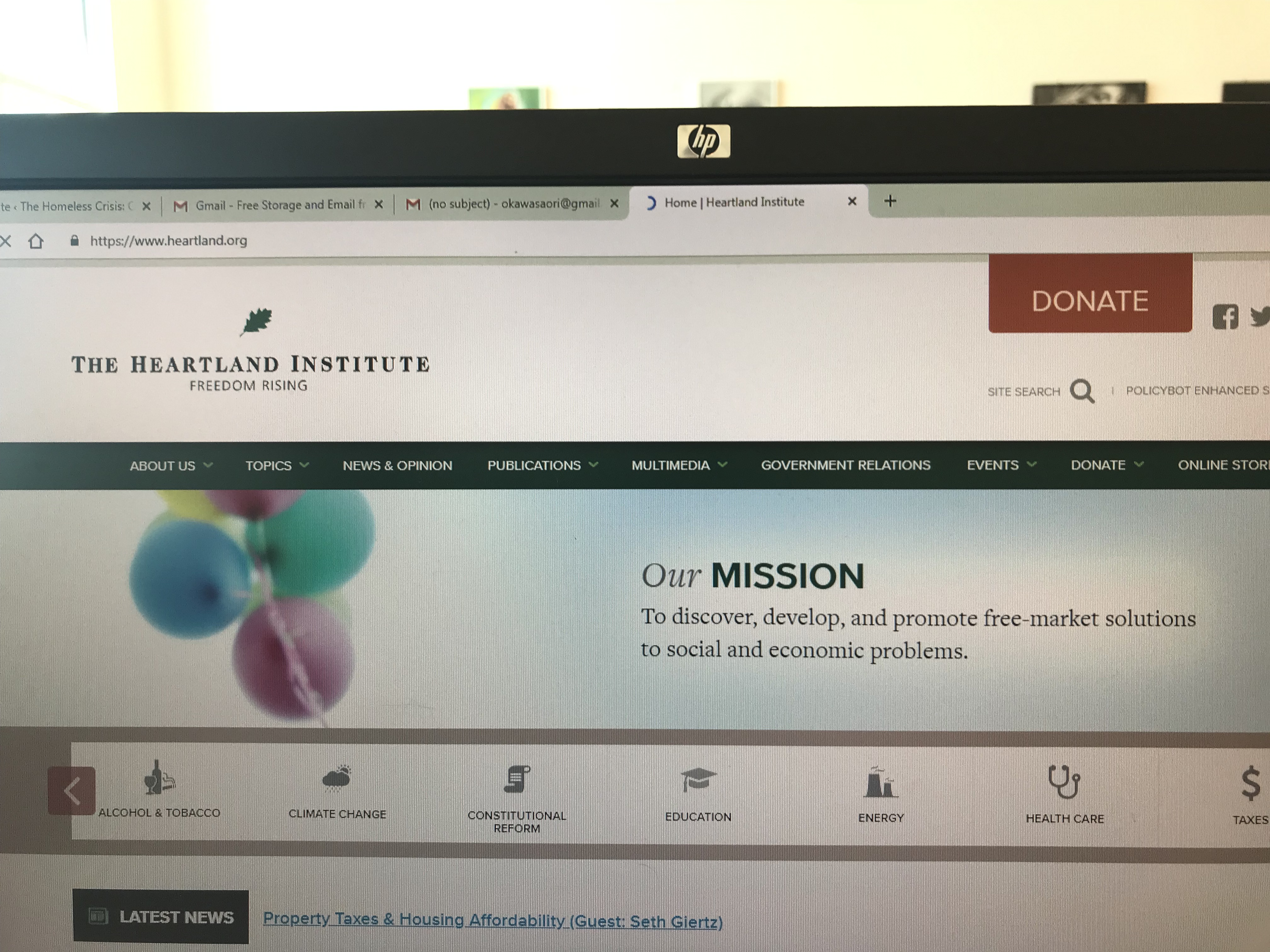
Instead of a warm welcoming sign, the Heartland Institute, the think tank that promotes “free-market,” “personal liberty” and “limited government,” puts forward a “Stopping Socialism” sign on the front page of their website.
Next that comes into view is The Heartland Institute’s mission, which is “to discover, develop, and promote free-market solutions to social and economic problems.” Due to the organization’s strong political bias, with its tendency towards manipulative tactics, the Heartland Institute appears not to be a credible source.
Christopher Talgo, the editor and the author of the Heartland Institute, lacks qualifying credentials and uses hyperbolic language to display his right wing bias. In the website, Talgo published his article, “Green New Deal Guarantees More Red Tape and Red Ink,” which includes the author’s About Page. According to his About Page, Talgo has been the editor of the Heartland Institute since 2017. He taught American history and government in Bluffton, South Carolina for five years and his hobby includes history and social science. A person with an editorial position should have qualifying credentials; however, Talgo lacks his credentials that would make him a credible source. There is no information about his educational background or information on where he taught and whether or not he has teaching credentials.
Talgo also published the same article in the blog, which is hosted by the Heartland Institute, called “The Heartland Freedom Pub.” This time, the blog introduces Talgo as the “marketing coordinator, “who is responsible for promoting the Heartland Institute, while the organization previously introduced him as the editor. Not only does he not have credentials to be an editor, but also he does not have credentials to be a marketing coordinator. This discrepancy in Talgo’s positions raises a question about credibility and authenticity of the author and the Heartland Institute.
In addition, Christopher Talgo published articles that indicate his biased viewpoints, which ultimately contributes to the organization’s lack of credibility. In Talgo’s article, “San Francisco Wants to Devastate its Economy to Help the Homeless,” he discusses Proposition C, which passed by 60 percent of the votes last November. It is a homeless tax measure that levies 0.5% in gross receipts tax on corporations that make more than $50 million, which will generate about $300 million a year towards homelessness. Talgo quotes, “However, despite the numerous benefits they’ve received from successful businesses, San Franciscans seem intent on taxing to death the golden geese that have made the Golden Gate City a modern mecca for technology.” First, the word, “death” is a very powerful word that elicits a strong negative emotion and “taxing to death” implies exaggeration. Talgo further writes, “The new taxes are so destructive that these voters have effectively decided to commit economic suicide.” The words, “destructive” and “suicide” are hyperbole, and they also denote extreme negativity. In addition, Talgo does not have an evidence to back up his claim that San Francisco will commit “economic suicide.” It is safe to say that the author is an alarmist with his excessive use of provocative words, and he is very forceful in his biased point of view. As a result, he diminishes his neutrality and his own credibility.
Talgo’s second article on February 14, 2019, “Green New Deal Guarantees More Red Tape and Red Ink” with a subheading, “No doubt most Americans have heard of Rep. Alexandria Ocasio-Cortez, D-N-Y., and her “Green New Deal,” is another example of the author and the organization’s political bias. Green New Deal is an economic and environmental policy that attempts to address climate change and bring economic reform (Friedman). According to the Oxford Dictionaries, “red tape” is defined as excessive bureaucracy or adherence to rules and formalities, especially in public business,” and “red ink” is also defined as “used in reference to financial deficit or debt.” Hence, the author suggests that Ocasio-Cortez’s Green New Deal is a sign of excessive government control which will lead to financial loss. Although the author uses multiple hyperlinks to back up his argument, he only uses references from only right wing sources such as Investor’s Business Daily, Reason, a website that promotes “free mind and free market,” and Mercatus Center, which is a conservative think tank. Because the author only uses right leaning sources, this shows his tendency towards extreme conservatism.
In addition, Talgo writes, “What Ocasio-Cortez doesn’t tell people is that her GND would bring an economic apocalypse that would totally bankrupt the nation.” However, “Economic apocalypse” is hyperbolic language. In an attempt to back up his negatively loaded language, he hyperlinked his quotation to the Investor’s Business Daily, another right leaning website that uses the word “socialism” to refer to Green New Deal. Talgo is very biased in his viewpoint because he only uses right-wing sources to back up his argument, and this ultimately makes him lose his credibility.
The Heartland Institute demonstrates lack of credibility due to inaccurate information-not supported by facts-generated from its narrow-mindedness. Jay Lehr, the science director, and Tom Harris, executive director at the Heartland Institute, published an article, “ Debunked: Humans Have Minimal Impact on Atmosphere’s Carbon Dioxide and Climate,” on February 14, 2019. The authors posit that “climate impacts of carbon dioxide” are minimal and calls global warming a “climate alarmism.” .” The authors further quote, “The claim that fossil-fuel emissions control atmospheric carbon-dioxide concentrations is also invalid, as atmospheric concentrations have gone up and down in the geological record, even without human influence.” The authors do not present any factual evidence and statistics to back up their statement, and there are no hyperlinks to any outside resources, which weaken their argument.
At the same time, NASA, National Aeronautics and Space Administration, which is an independent agency of the United States Federal Government, published an article in their website, “Carbon Dioxide Controls Earth’s Temperature” on October 14, 2010. In the article, Kathryn Hansen claims, “It is not surprising then that global warming can be linked directly to the observed increase in atmospheric carbon dioxide and to human industrial activity in general.” NASA’s report clearly disputes the Heartland Institute’s statement that human activities do not influence emission of carbon dioxide and global warming. It is apparent that the Heartland Institute ignores scientific findings backed up by a distinguished and nationally acclaimed organization like NASAand distorts truth so that they can construct their faulty and biased argument doubting human-caused climate change.
The Heartland Institute is not a credible website due to the organization’s unfair, one-sided view. A 2012 New York Times article, “Leak Offers Glimpse of Campaign Against Climate Science” written by Justin Gillis and Leslie Kaufman, refutes the Heartland Institute’s credibility because of its stance on denial of global warming. According to the information provided by the New York Times, Justin is a contributing opinion writer for the New York Times and he is writing a book on how to solve global warming, and Leslie Kaufman is a communication strategist. Gillis and Kaufman claim that the Heartland Institute has received funds from various corporations that deny climate change, and the authors show concern towards the Heartland Institute’s intention to instill a curriculum against climate change in public schools. The authors question the Heartland Institute’s belief, “whether humans are changing the climate is a major scientific controversy.” To back their argument, the authors of the article claim that there is a significant amount of evidence which supports that “emissions generated by humans are changing the climate and putting the planet at long-term risk.” They further quote the program and policy director of the National Center for Science Education, “they (the Heartland Institute) continue to promote confusion, doubt and debate where there really is none.” Given this article, the Heartland Institute is not a credible organization because it ignores scientific evidence backed up many scientists regarding the global warming and the climate change.
Science Magazine, a peer-reviewed journal and a very reputable source known for its high factual reporting, has also discredited the Heartland Institute for the organization’s unreliable research finding. They published the article, “Climate Change Doubters are Finalists for Environmental Protection Agency Science Advisory Board” on October 18, 2018. In the article, the author, Scott Waldman, struggles hard to hide his concern that United States Environmental Protection Agency’s nominees included those who refute climate change. Waldman states that among those nominees is James Enstrom, a “policy advisor for the Heartland Institute,” whose research has reached “vastly different conclusions from those of the majority of scientists,” and is “scientifically unjustified and must undergo complete and objective reassessment.” Undeniably, Science Magazine shows that the Heartland Institute lacks its credibility because of its inaccurate interpretation of findings by majority of scientists.
Conclusion
In summary, it would not be an exaggeration to say that the Heartland Institute is a biased political organization intended to promote extreme right-wing agenda. Because the organization blatantly ignores scientific evidence and misuses information to align with its purpose, the Heartland Institute is not a credible website.
Works Cited
The Heartland
Institute, 2019, www.heartland.org. Accessed 15 Mar 2019.
Rhetorical Analysis of the New York Times article, “San Francisco, Rich and Poor, Turns to Simple Street Solutions that Underscore the City’s Complexities”
In the article, “San Francisco, Rich and Poor, Turns to Simple Street Solutions that Underscore the City’s Complexities,” published in 2018 on The Washington Post, Scott Wilson describes San Francisco as “among the most exciting and puzzling in the nation.” As a senior national correspondent for The Washington Post who has been covering California and the West, Wilson emphasizes that the city has generated a lot of wealth from tech industry but seems to be at a loss when it comes to handling its social problems. In the article, Wilson uses the words, “eccentric” and “contradictory” to describe San Francisco Mayor London Breed’s policies, including the city’s decision to freely distribute plastic caps of needle holders to heroin addicts on streets while banning plastic drinking straws to prevent pollution. By using irony, oxymoron, and juxtaposition, the author effectively shows the contrast between Mayor Breed’s confident but unsuccessful approach to dealing with homelessness.
To start, Wilson familiarizes the audience with San Francisco by introducing streets of San Francisco as “hilly, curvy, cinematic” and at the same time, “a bleak showcase for the mentally ill and economically displaced” because of the expansion of tech industry and how it created socio-economic inequality. The author further raises a question whether the city is effectively spending its “quarter-billion dollars a year” on homelessness by introducing San Francisco Mayor London Breed and her priorities.
What does the author suggest through the title?
Wilson’s use of contrast in the title evokes a sense of irony, thereby questioning Mayor Breed’s insufficient governing polices. According to Oxford Dictionaries, irony is defined as “the expression of one’s meaning by using language that normally signifies the opposite, typically for humorous or emphatic effect.” The title of the article is “San Francisco, Rich and Poor, Turns to Simple Street Solutions that Underscore the City’s Complexities” and since “simple” and “complexities” are opposite in meanings, the audience can sense the author’s ironic tone from the start. The author uses this strategy to insinuate that the city’s simple approach may not be enough in dealing with its complicated social problems. The author successfully uses irony in the title to appeal to readers’ logic by setting the tone of sarcasm, catch readers’ attention, and encourage curiosity in finding out the city’s insufficient measures.
What does the author suggest through the introduction ?
Wilson’s use of contrast in the introduction evokes another irony to highlight Mayor Breed’s impractical measures. According to Oxford Dictionaries, irony is also defined as “a state of affairs or an event that seems deliberately contrary to what one expects and is often amusing as a result.” He mentions that people can see piles of “sterile plastic caps to hypodermic needles,”on streets, which are freely distributed by the City to heroin addicts on streets. At the same time, Wilson mentions that the city previously banned drinking straws to prevent plastics from being washed into San Francisco Bay and cause pollution. This contrast amuses the audience because it prompts them to wonder why the city banned one plastic and not the other. The author employs a mocking tone because the city’s measures are contradictory. He successfully appeals to the audience’s intellect, allowing them to draw their own conclusion on this ironic situation.
What is San Francisco Mayor London Breed’s approach to homelessness
The author also uses another contrast, oxymoron, in his attempt to describe Mayor Breed’s incompetent approach to homelessness. Wilson challenges Mayor’s “get the simple things done quickly” approach by stating an oxymoron, “simple and hugely complex.” This is to say that the author casts a doubt on Mayor’s “simple” approach, which is to make the streets very clean and offer housing to homeless people at the same time.
Further, Wilson describes Mayor’s “get the simple things done quickly” as her attempts to employ “poop patrols” to clean feces off the streets and building safe injection sites so the city can temporarily hide heroin addicts off the streets. The author then introduces a quote from a volunteer for a nonprofit organization, who states that the shelters are still full in the city. By contrasting Mayor’s priorities and the volunteer worker’s quote, the author successfully implies cynicism and convinces readers that “poop patrols” and “safe injection sites” are not practical answers to alleviating homelessness. The complexity of this reality is reflected in this contrast. Thus, going back to the author’s oxymoron, “simple and hugely complex,” the author effectively raises a concern whether keeping the aesthetic of streets are more important than proving safe places for homeless people.
Wilson’s use of juxtaposition to describe Market Street is effective in raising a question about Mayor’s measures. Oxford Dictionaries defines juxtaposition as “the fact of two things being seen or placed close together with contrasting effect.” Wilson describes a line separating Market Street from glamorous parts to its not so glamorous southern parts. The glamorous part includes offices of Twitter, SF Fitness with its fancy glass doored spinning classes and lunch trucks that serve tuna poke and tacos to tech workers. He also describes that next to such scenery, passersby can see “an open-air heroin shooting gallery” where homeless people shoot up on streets. Through the use of juxtaposition, the author attempts to appeal to the audience’s sympathy. The powerful imagery of Market street, which depicts the rich and the poor, is an effective way to let the audience question the city’s measures because such scenery shows that the city is not spending its budget on homelessness wisely.
The author presents and contrasts four quotes to build his argument that Mayor’s governing policies are inefficient. The author first establishes credibility by citing Mayor Breed and uses her quotes to question whether her approach to homelessness is ethical or not. The author quotes Mayor, “I want people to walk around this city and think ‘wow it’s so clean here’” The author believes that Mayor’s “down-and-very-dirty approach” to addressing homelessness as part of her “legacy” is reflected in how she employs “poop patrol” to clean feces and implement safe injection sites to those heroin addicts on streets.
The author further establishes credibility by introducing a quote by Jeffrey Ouyang, a worker for the tech start-up Zumper, a real estate search site. Witnessing a sharp increase in housing costs, Jeffrey quotes, “You begin to wonder about all the tax dollars and whether they are spent in the right way… Poverty and homelessness have gotten progressively worse despite the city’s rising tax. You begin to think about impact and whether we have any of it right.” By introducing this quote, the author successfully hints Mayor’s incompetent measures because the source is from a tech worker who actually walks the streets and wonder why poverty and homelessness is getting worse despite the city’s huge spending on homelessness.
Wilson also establishes his credibility by introducing Jessica Doing, a nonprofit worker for an organization that connects homeless people with their families. Jessica laments that people are willing to help homeless people but they do not know where to start or what to do. The author quotes Jessica, “What I see is that people are compassionate, but they don’t know what to do. And they don’t want to look in the eye without some kind of solution.” The quote suggests that a credible source has witnessed lack of organizations nor leadership from the city to solve the problems and that city may need to take more time to build these organizations.
Lastly, the author further establishes his credibility and strengthens his argument by quoting Regina Pina, the office manager at Zumper. Regina commutes to San Francisco from Tracy and is surprised to see homelessness. The author quotes Regina, “And it makes me anxious. But the shelters are full, and I don’t see that many other organizations out here.” The author uses this quote to convince readers that at the end of the day, despite the city’s effort to make the streets clean, the core problem of giving safe places for homeless people is not addressed at all.
The author compares all of these four quotes to confront Mayor’s measures in addressing homelessness. Through the use of comparison, the author demonstrates that Mayor’s “Poop patrol” and “safe injection sites” are not effective because despite the city’s huge spending on tax for homelessness, poverty is getting worse on streets, volunteers do not know what to do or where to start and shelters are still full. Using various credible sources, the author successfully persuades readers to take on his viewpoint.
Conclusion
Ultimately , through a series of contrast, Scott Wilson eloquently conveys Mayor Breed’s incompetent approach to dealing with homelessness. The author ends the article with a quote from Regina, “And it makes me anxious. But the shelters are full, and I don’t see that many other organizations out here.” The author clearly implies that the current situation seems discouraging because of the complex nature of homelessness and promising solutions seem still up in the air.
“We think sometimes that poverty is only being hungry, naked and homeless. The poverty of being unwanted, unloved and uncared for is the greatest poverty. We must start in our own homes to remedy this kind of poverty” -Mother Teresa
Is
San Francisco, one of the wealthiest cities in America, like Mumbai?
In January 2018, upon witnessing the homeless crisis in San Francisco, UN housing expert, Leilani Farha, called the treatment of the homeless “cruel and inhuman” and was alarmed to see the “violation of human rights” in a similar way as she had seen in the streets of Mumbai (Bendix). The article “UN Report: San Francisco’s ‘cruel’ and ‘inhuman’ homelessness crisis is a human rights violations ,” the author, Aria Bendix, describes that the humanitarian crisis is as bad in San Francisco as it is in Mumbai by quoting Farha that San Francisco and Oakland residents “were denied access to water, sanitation and health services, and other basic necessities.” Bendix further illustrates Farha’s disbelief when she saw tent encampments that were filled with “trash,” “feces,” and “needles.”
It is very disheartening that San Francisco has not been able to provide the most basic necessities to its residents even though it is one of the wealthiest cities in America today. According to the article from The New York Times, “San Francisco is So Expensive, You can Make Six Figures and Still Be ‘Low Income‘,” San Francisco is the most expensive city in America where the median home price is above $1 million, and where the federal government classifies $117,400 earning of family four as low income. Therefore, it is very ironic that Farha called conditions of homeless people in such a wealthy city “inhuman,” just as those in Mumbai, one of the poorest countries in the world. While Mumbai does not have enough resources to support their homeless population due to its nationwide poverty, the city that generated massive wealth from the tech industry should be capable of having means to alleviate its social problem.
While tech companies have been successful in contributing wealth, they were also the cause of soaring housing prices and rent. In the article in The Guardian, “Is San Francisco Losing its Soul?” the author, Zoe Corbyn, claims that since 2011, “the influx” of tech workers caused rise in rent and housing prices, which led to many evictions of long time residents and gentrification. According to the author, the tech boom has caused “significant tension” by impacting lives of many people by making housing unaffordable in San Francisco and causing displacement of many people out on streets. Therefore, businesses, especially tech companies, should assert their social responsibility in addressing the homeless crisis because their involvement will inspire the community of San Francisco to turn its attention to the homeless crisis and get involved in finally finding solutions to this long-standing problem.
The homeless crisis is said to have exploded in the late 70’s and early 80’s in San Francisco and throughout the nation as a result of Ronald Reagan’s “deinstitutionalization” policy or closing of state mental hospitals and reduction of federal funding. Many mentally ill patients were put out in the society without proper support and subsidized housing for the poor were virtually out of the question (Fennelly).
Homelessness
has been there since 1980. Why tech companies ?
The influx of technology industries from 2011 exacerbated the homeless problems in San Francisco. As result of Mayor Ed Lee’s tax break for tech companies to revitalize downtown, San Francisco transformed into a mega magnet for tech companies. This caused the Tech Boom that resulted in gentrification, outrageous rent and soaring housing prices, causing homelessness in San Francisco to worsen (Corbyn). San Jose, home of Silicon Valley, about 70 percent of surveyed homeless population claimed that they became homeless because of high rent(Chen). This is significant because many homeless people were not necessarily mentally ill or drug abusers. Instead, they were normal working people who simply couldn’t afford housing.
A Recent Zillow study published by Finance Yahoo found a specific correlation between rent affordability and homelessness in “High Rent in America Leading to Homelessness.” In San Francisco, the boom in tech industry is said to cause the rise in housing prices. Even though the number of homeless people has not changed much from 2004, the visibility of homelessness increased because many residents were forced out of their living spaces from gentrification and not enough affordable housing was available.
This all means that we can end up on the streets anytime with sky high rent prices and unavailability of affordable housing! Even if we have a full time job, one job might not be enough to pay rent and living expenses, forcing us to have more than one job. Because tech industries are competitive, one loss of a job can put us out on the streets at anytime. This is not just an issue for homeless people. This is also an issue for us living in the city where affordable housing has become very difficult!
I am interested in this topic
because I was a volunteer at Information Desk at St. Francis Memorial Hospital
in Tenderloin, San Francisco for 8 months and saw countless numbers of homeless
people come into the hospital for emergency treatments only to be politely
turned away. Seeing their situations made me think if there could possibly be healthcare
services designed to treat these homeless people especially in the fields of
mental care and substance abuse services.
In addition, I encountered many homeless people while walking my dog in
the park called Raymond Kimball Playground in Japan town. A lot of homeless people lived in the cars by
the park and they had dogs, and I would chat with them almost daily. My
impression of them was that they were very sweet, almost too sweet to the point
that they became vulnerable for that reason. For the first time, my mindset
shifted from “homelessness is not my problem” and “homeless people are to be
blamed for their situations” to “Is there anything we can do about it?”
Cause
of the homelessness
Today, over 100 people die each
year on the streets while over 9,000 are without permanent homes in San
Francisco according to the report on “Homelessness
in San Francisco” submitted by The City and County of San Francisco.
In addition, these are some major
factors that caused the homelessness.
Poverty, lack of permanent housing and temporary shelters are the major causes of homelessness. Also, lack of health care service to treat the homeless people contributes to the problem.
“Historical policy decisions on the state and federal level” pointing to Reagan Administration’s policy of “deinstitutionalization” or closing of state mental hospitals and reduction of federal funding of subsidized housing in 1981. This policy has been said to cause the rapid increase in numbers of homeless people in America.
Lack of effective management, coordination, leadership in the homeless programs such as centralized tracking system for homeless people, enhanced shelter systems and public education programs to raise awareness on the homelessness within the community.
This suggests that there needs to be more HOUSING! On top of that, there needs to be more FUNDING to develop housing ! Temporary housing may help, but permanent housing is the real solution. Also, the city of San Francisco needs to select leaders who will take aggressive steps in improving the homeless programs. Somebody has to take an aggressive action!
In BETA, the website that introduces new HIV prevention and treatment, Emily Land introduces an article, “What it’s like to provide HIV care to people without housing.” In the article, Land features Erin Collins, a clinical social worker who provides case management and social services to people living with HIV experiencing homelessness in San Francisco. Erin emphasizes the importance of securing housing for homeless people. She quotes: “Housing is really the most important thing. San Francisco has many services and resources for people living with HIV, but at the end of the day, people can’t address their medical care until they are in a safe environment to do so. It’s hard to focus on a accomplishing a daily task, like taking your meds, when you have to worry about where you’re going to sleep that night.”
As Erin suggests, the city should prioritize securing safe places for homeless people. Providing a safe places significantly improves the lives of people living on the streets by allowing social workers to frequently visit and check up on their conditions.
By 2016, San Francisco spent $241 million annually on housing homeless residents yet not much improvement was seen on decreasing numbers of homeless people according to “S.F spends record $241 million on homeless, can’t track results” (Knight and Fagan). Despite such funding, there has not been enough improvement in the shortage of shelters and affordable housing which leads to public sanitation issues like urine odor, human feces, countless used needles, and homeless encampments on sidewalks. Again, lack of housing is the main problem.
Last year in November, Proposition C passed by 61 % of the vote in San Francisco, which will tax companies with a gross income of more than $50 million to contribute to the funds that will go towards homeless programs. However, it is in a legal dispute, and Mayor London Breed is trying to fix and speed up the process so that funding will be available sooner to be put into use (Conger).
What
is Proposition C and why is it worth mentioning?
Proposition C brought much-needed
attention back to the homeless crisis to the community of San Francisco. A lot
of residents have turned indifferent to the helpless issue over the years by
delegating responsibility to the government.
The result? We pass by every so many more homeless people begging for
our change and encampments that occupy some of the streets.
According to Our City, Our Home
2018, Yes on C, the committee funded by Coalition on Homelessness and
Salesforce, Proposition C will raise about $250-300 million annually from tax
levied to businesses that earn more than $50 million in total income. Some of
the plans suggested in the funding will be:
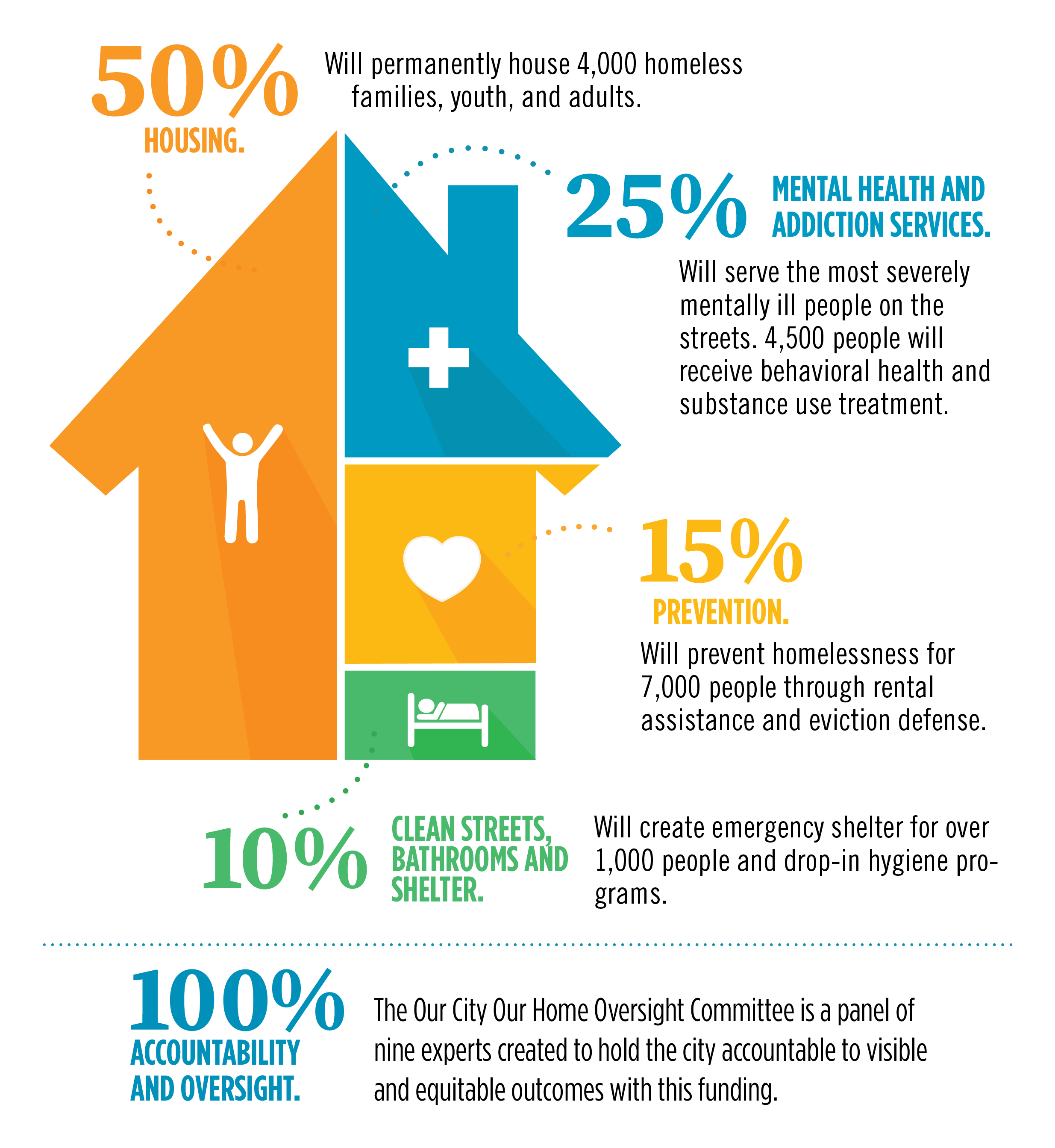
50% of
the fund will go to permanent housing, such as construction, rehab, prevention
and operating about 4,000 new units of housing over the next 8 years.
25% will
be used to provide service for housing and treating homeless people suffering
from mental illness and substance use disorder
12% will
go towards preventing homelessness such as providing legal assistance in making
sure people are not forced out of residence.
Eliminate
shelter waitlist and help keep streets clean.
This new measure allows promising future in the areas that need improvement, and it also justifies tech companies’ involvement in improving the homeless programs.
Supporting
view of tech companies’ involvement in the homeless crisis
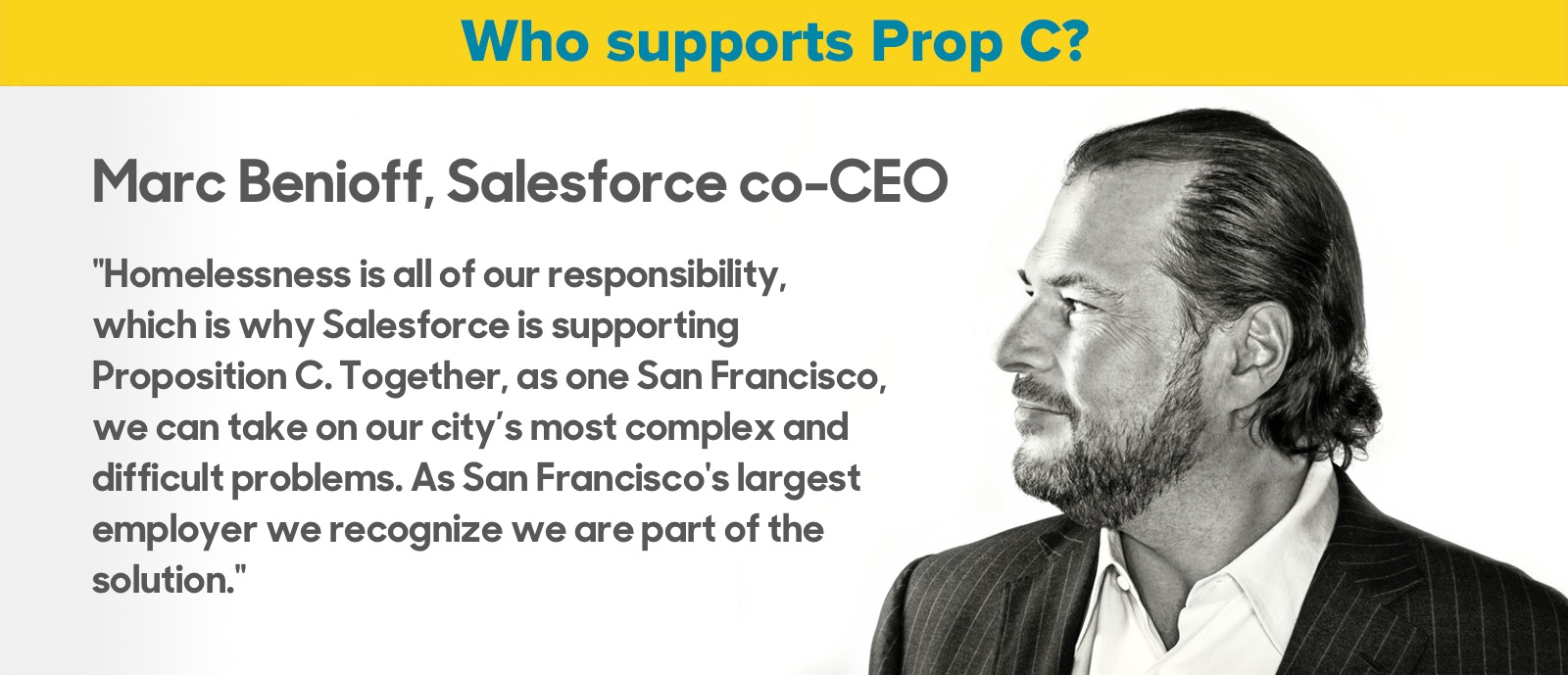
Let’s take a look at why tech companies should be involved with the homeless crisis. Marc Benioff, CEO of Salesforce, San Francisco’s prominent tech corporation, called forth an attention for businesses to be more involved in the homeless problems. In “The Social Responsibility of Business” in the New York Times, Marc quoted, “business of business is no longer merely business…companies can truly thrive only when our communities succeed as well…when we protect our environment and when our residents are no longer forced out of their homes and onto the streets.” It means that businesses should be held accountable to the environment and the communities in which preside. Doing so not only help the homeless problems but also the companies and the whole community of San Francisco.
Opposing
view of tech companies’ involvement in homeless crisis
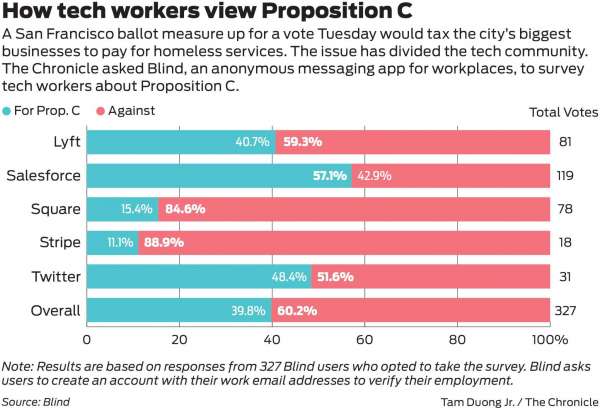
Let’s take a look at why tech companies do not need to be involved in the homeless crisis. CEO of Twitter, Jack Dorsey, opposed that companies are not responsible and are not “best equipped” to deal with the homelessness crisis. Instead, he believes that the city of San Francisco will take a necessary action to solve this problem (Conger). He also stated that opposing to be involved in homeless crisis “feels like the right thing to do to get into the nuance and bring out more of the concerns.” Here, we can see that he believes simply adding more funds isn’t the solution and that there should be a change in how the previous funding is being used.
According to No Plan, No Accountability, No on Prop C, a committee funded from Stripe owned by Dorsey, Visa and SF Forward, this largest tax increase in the history of San Francisco will eliminate middle class jobs because it will affect businesses that are affected to leave San Francisco. In addition, San Francisco is already spending the most in the nation towards homelessness and unless there is a better reform in the plan and a centralized system for tracking services for homelessness, adding more funds will not be the solution.
My personal reflections on this topic
Though I am a fan of Proposition C, I am open minded about the topic. On one hand, I feel that more funding from corporations never hurts as Marc quoted, “It’s also true that all effective solutions require money.” in the article, “The Social Responsibility” in The New York Times.
However, in The New York Time‘s article, “In Liberal San Francisco, Tech Leaders Brawl over Tax Proposal to Aid Homeless,” San Francisco Mayor London Breed initially opposed to this tax proposal by asserting that better allocation of funding and systematic planning is more important than hastily taxing the corporations. I agree because if the funding is not spent efficiently, even an increase in funding will not help solve the homeless crisis since San Francisco is already spending a lot of money on the homeless programs.
The next question is: What can tech companies do to help address the homeless crisis, which they helped to exacerbate in San Francisco?
Works Cited
United States, City and County of San Francisco Civil Grand Jury,


























 The Homeless Crisis: Can Tech Companies Help San Francisco?