“We think sometimes that poverty is only being hungry, naked and homeless. The poverty of being unwanted, unloved and uncared for is the greatest poverty. We must start in our own homes to remedy this kind of poverty” -Mother Teresa

source: www.pinterest.co.uk
Is San Francisco, one of the wealthiest cities in America, like Mumbai?
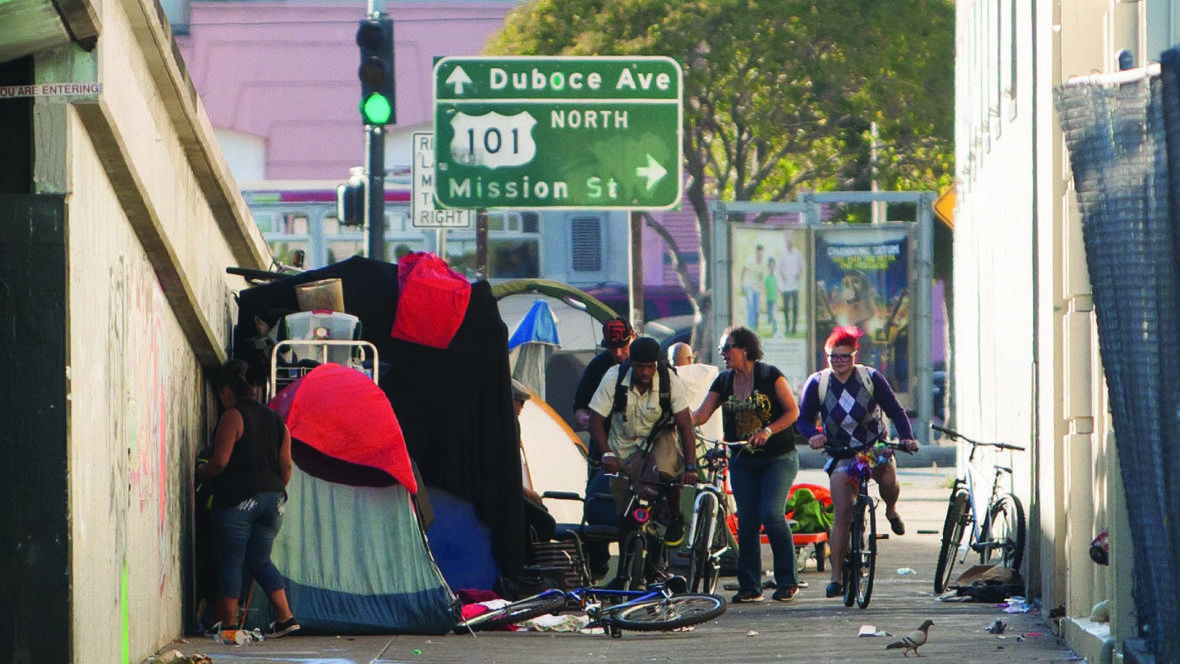
In January 2018, upon witnessing the homeless crisis in San Francisco, UN housing expert, Leilani Farha, called the treatment of the homeless “cruel and inhuman” and was alarmed to see the “violation of human rights” in a similar way as she had seen in the streets of Mumbai (Bendix). The article “UN Report: San Francisco’s ‘cruel’ and ‘inhuman’ homelessness crisis is a human rights violations ,” the author, Aria Bendix, describes that the humanitarian crisis is as bad in San Francisco as it is in Mumbai by quoting Farha that San Francisco and Oakland residents “were denied access to water, sanitation and health services, and other basic necessities.” Bendix further illustrates Farha’s disbelief when she saw tent encampments that were filled with “trash,” “feces,” and “needles.”
It is very disheartening that San Francisco has not been able to provide the most basic necessities to its residents even though it is one of the wealthiest cities in America today. According to the article from The New York Times, “San Francisco is So Expensive, You can Make Six Figures and Still Be ‘Low Income‘,” San Francisco is the most expensive city in America where the median home price is above $1 million, and where the federal government classifies $117,400 earning of family four as low income. Therefore, it is very ironic that Farha called conditions of homeless people in such a wealthy city “inhuman,” just as those in Mumbai, one of the poorest countries in the world. While Mumbai does not have enough resources to support their homeless population due to its nationwide poverty, the city that generated massive wealth from the tech industry should be capable of having means to alleviate its social problem.

Tech Companies and San Francisco
While tech companies have been successful in contributing wealth, they were also the cause of soaring housing prices and rent. In the article in The Guardian, “Is San Francisco Losing its Soul?” the author, Zoe Corbyn, claims that since 2011, “the influx” of tech workers caused rise in rent and housing prices, which led to many evictions of long time residents and gentrification. According to the author, the tech boom has caused “significant tension” by impacting lives of many people by making housing unaffordable in San Francisco and causing displacement of many people out on streets. Therefore, businesses, especially tech companies, should assert their social responsibility in addressing the homeless crisis because their involvement will inspire the community of San Francisco to turn its attention to the homeless crisis and get involved in finally finding solutions to this long-standing problem.
How did homelessness emerge in San Francisco?
The homeless crisis is said to have exploded in the late 70’s and early 80’s in San Francisco and throughout the nation as a result of Ronald Reagan’s “deinstitutionalization” policy or closing of state mental hospitals and reduction of federal funding. Many mentally ill patients were put out in the society without proper support and subsidized housing for the poor were virtually out of the question (Fennelly).
Homelessness has been there since 1980. Why tech companies ?
The influx of technology industries from 2011 exacerbated the homeless problems in San Francisco. As result of Mayor Ed Lee’s tax break for tech companies to revitalize downtown, San Francisco transformed into a mega magnet for tech companies. This caused the Tech Boom that resulted in gentrification, outrageous rent and soaring housing prices, causing homelessness in San Francisco to worsen (Corbyn). San Jose, home of Silicon Valley, about 70 percent of surveyed homeless population claimed that they became homeless because of high rent(Chen). This is significant because many homeless people were not necessarily mentally ill or drug abusers. Instead, they were normal working people who simply couldn’t afford housing.
A Recent Zillow study published by Finance Yahoo found a specific correlation between rent affordability and homelessness in “High Rent in America Leading to Homelessness.” In San Francisco, the boom in tech industry is said to cause the rise in housing prices. Even though the number of homeless people has not changed much from 2004, the visibility of homelessness increased because many residents were forced out of their living spaces from gentrification and not enough affordable housing was available.
This all means that we can end up on the streets anytime with sky high rent prices and unavailability of affordable housing! Even if we have a full time job, one job might not be enough to pay rent and living expenses, forcing us to have more than one job. Because tech industries are competitive, one loss of a job can put us out on the streets at anytime. This is not just an issue for homeless people. This is also an issue for us living in the city where affordable housing has become very difficult!
source: hoodline.com
Personal Interest
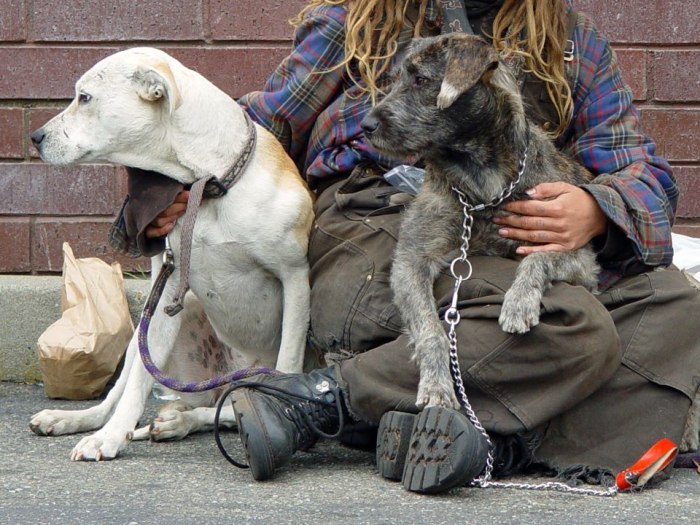
I am interested in this topic because I was a volunteer at Information Desk at St. Francis Memorial Hospital in Tenderloin, San Francisco for 8 months and saw countless numbers of homeless people come into the hospital for emergency treatments only to be politely turned away. Seeing their situations made me think if there could possibly be healthcare services designed to treat these homeless people especially in the fields of mental care and substance abuse services. In addition, I encountered many homeless people while walking my dog in the park called Raymond Kimball Playground in Japan town. A lot of homeless people lived in the cars by the park and they had dogs, and I would chat with them almost daily. My impression of them was that they were very sweet, almost too sweet to the point that they became vulnerable for that reason. For the first time, my mindset shifted from “homelessness is not my problem” and “homeless people are to be blamed for their situations” to “Is there anything we can do about it?”
Cause of the homelessness
Today, over 100 people die each year on the streets while over 9,000 are without permanent homes in San Francisco according to the report on “Homelessness in San Francisco” submitted by The City and County of San Francisco. In addition, these are some major factors that caused the homelessness.
- Poverty, lack of permanent housing and temporary shelters are the major causes of homelessness. Also, lack of health care service to treat the homeless people contributes to the problem.
- “Historical policy decisions on the state and federal level” pointing to Reagan Administration’s policy of “deinstitutionalization” or closing of state mental hospitals and reduction of federal funding of subsidized housing in 1981. This policy has been said to cause the rapid increase in numbers of homeless people in America.
- Lack of effective management, coordination, leadership in the homeless programs such as centralized tracking system for homeless people, enhanced shelter systems and public education programs to raise awareness on the homelessness within the community.
This suggests that there needs to be more HOUSING! On top of that, there needs to be more FUNDING to develop housing ! Temporary housing may help, but permanent housing is the real solution. Also, the city of San Francisco needs to select leaders who will take aggressive steps in improving the homeless programs. Somebody has to take an aggressive action!
In BETA, the website that introduces new HIV prevention and treatment, Emily Land introduces an article, “What it’s like to provide HIV care to people without housing.” In the article, Land features Erin Collins, a clinical social worker who provides case management and social services to people living with HIV experiencing homelessness in San Francisco. Erin emphasizes the importance of securing housing for homeless people. She quotes:
“Housing is really the most important thing. San Francisco has many services and resources for people living with HIV, but at the end of the day, people can’t address their medical care until they are in a safe environment to do so. It’s hard to focus on a accomplishing a daily task, like taking your meds, when you have to worry about where you’re going to sleep that night.”
As Erin suggests, the city should prioritize securing safe places for homeless people. Providing a safe places significantly improves the lives of people living on the streets by allowing social workers to frequently visit and check up on their conditions.
What efforts have been made to address the issue?
2016
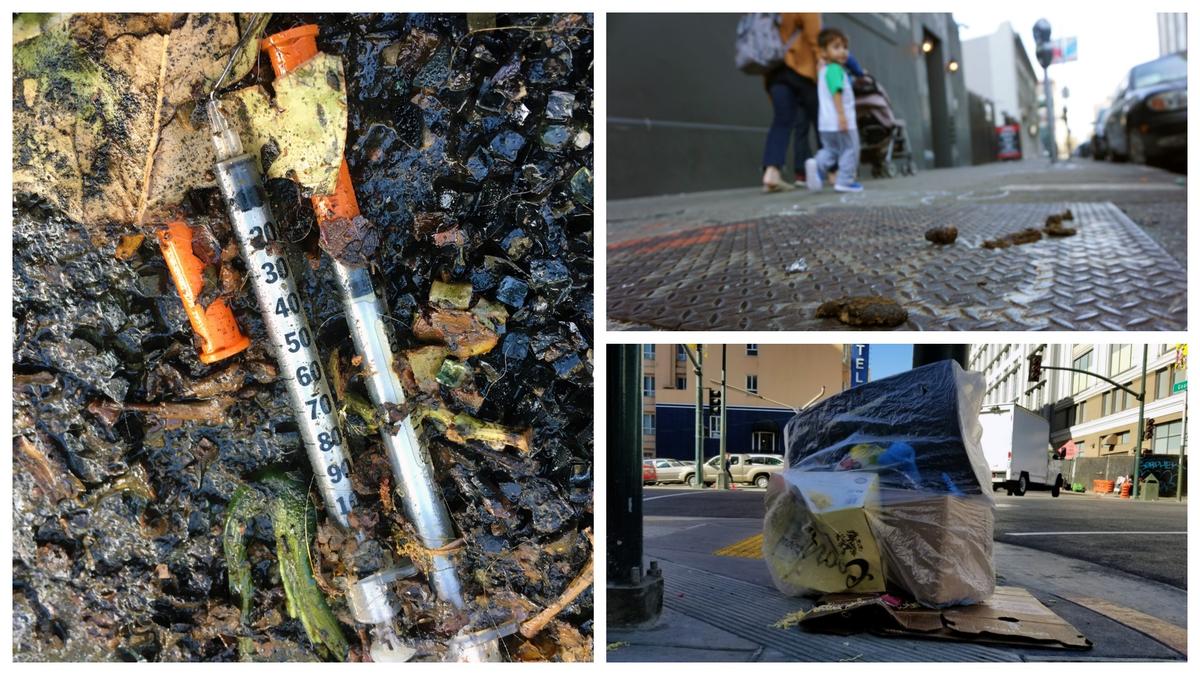
By 2016, San Francisco spent $241 million annually on housing homeless residents yet not much improvement was seen on decreasing numbers of homeless people according to “S.F spends record $241 million on homeless, can’t track results” (Knight and Fagan). Despite such funding, there has not been enough improvement in the shortage of shelters and affordable housing which leads to public sanitation issues like urine odor, human feces, countless used needles, and homeless encampments on sidewalks. Again, lack of housing is the main problem.
2018
Last year in November, Proposition C passed by 61 % of the vote in San Francisco, which will tax companies with a gross income of more than $50 million to contribute to the funds that will go towards homeless programs. However, it is in a legal dispute, and Mayor London Breed is trying to fix and speed up the process so that funding will be available sooner to be put into use (Conger).
What is Proposition C and why is it worth mentioning?
Proposition C brought much-needed attention back to the homeless crisis to the community of San Francisco. A lot of residents have turned indifferent to the helpless issue over the years by delegating responsibility to the government. The result? We pass by every so many more homeless people begging for our change and encampments that occupy some of the streets.
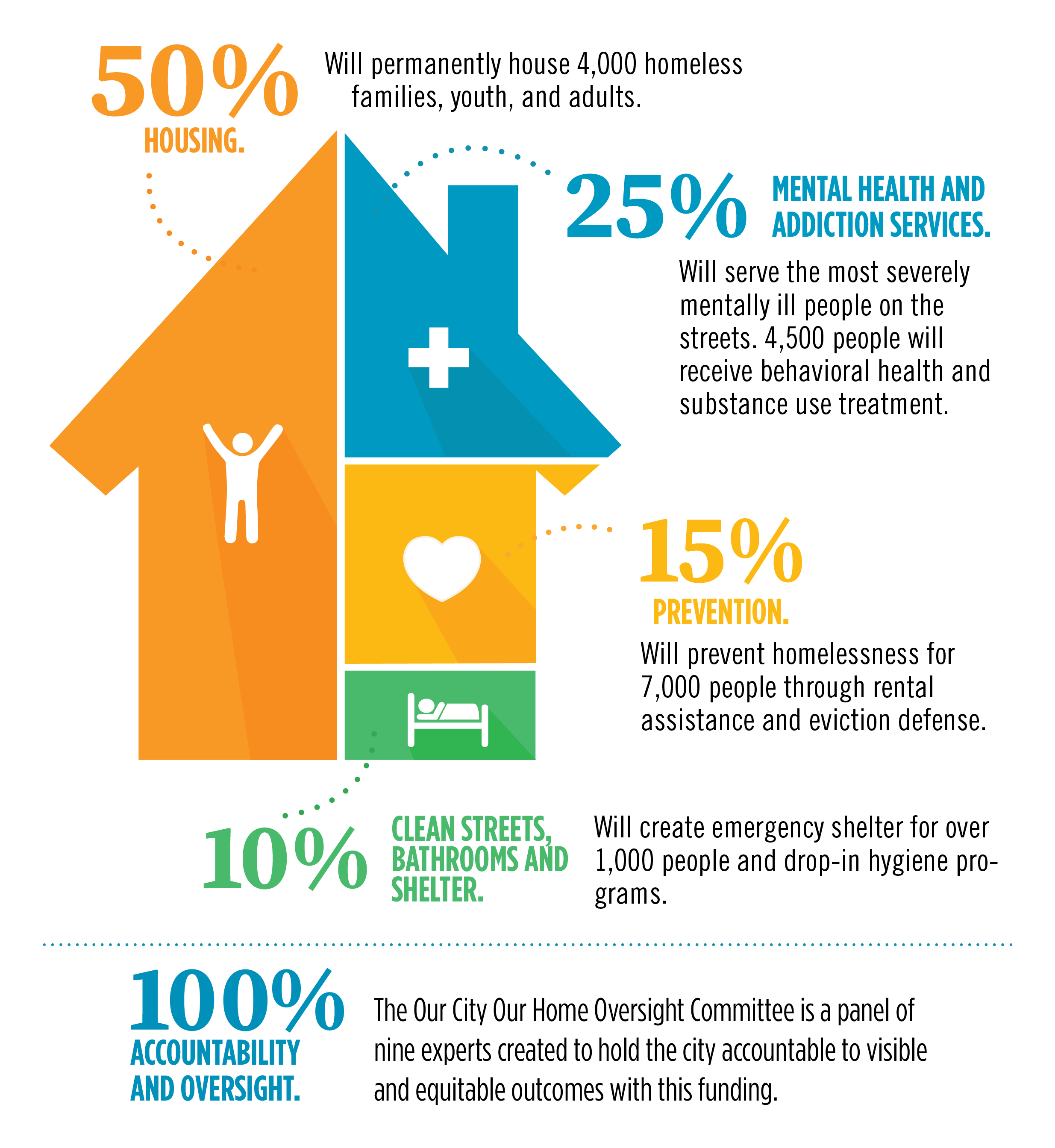
According to Our City, Our Home 2018, Yes on C, the committee funded by Coalition on Homelessness and Salesforce, Proposition C will raise about $250-300 million annually from tax levied to businesses that earn more than $50 million in total income. Some of the plans suggested in the funding will be:
- 50% of the fund will go to permanent housing, such as construction, rehab, prevention and operating about 4,000 new units of housing over the next 8 years.
- 25% will be used to provide service for housing and treating homeless people suffering from mental illness and substance use disorder
- 12% will go towards preventing homelessness such as providing legal assistance in making sure people are not forced out of residence.
- Eliminate shelter waitlist and help keep streets clean.
This new measure allows promising future in the areas that need improvement, and it also justifies tech companies’ involvement in improving the homeless programs.
Supporting view of tech companies’ involvement in the homeless crisis
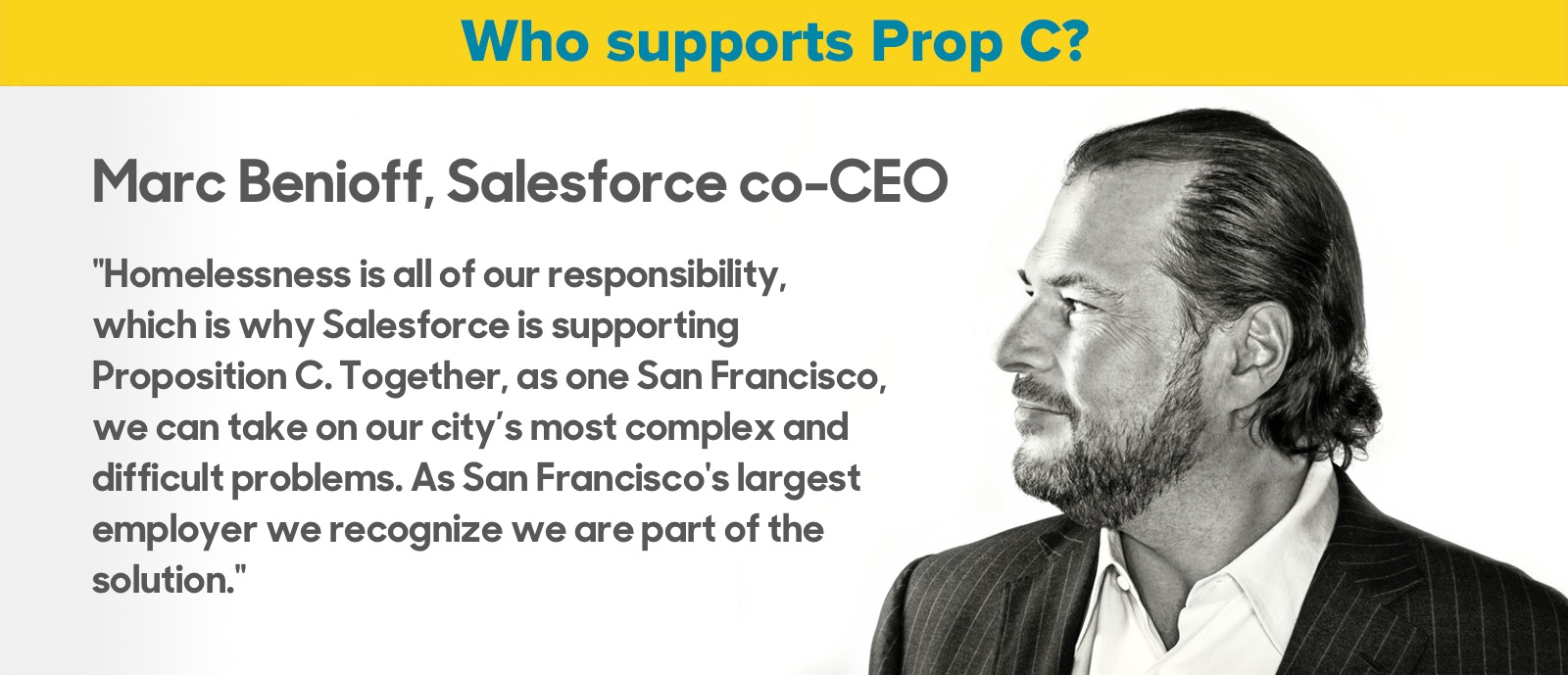
Let’s take a look at why tech companies should be involved with the homeless crisis. Marc Benioff, CEO of Salesforce, San Francisco’s prominent tech corporation, called forth an attention for businesses to be more involved in the homeless problems. In “The Social Responsibility of Business” in the New York Times, Marc quoted, “business of business is no longer merely business…companies can truly thrive only when our communities succeed as well…when we protect our environment and when our residents are no longer forced out of their homes and onto the streets.” It means that businesses should be held accountable to the environment and the communities in which preside. Doing so not only help the homeless problems but also the companies and the whole community of San Francisco.
Opposing view of tech companies’ involvement in homeless crisis
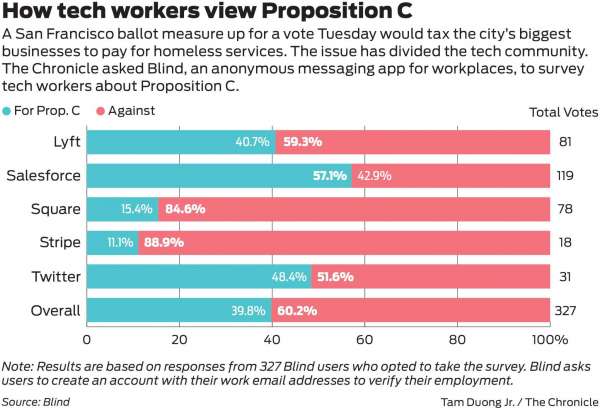
Let’s take a look at why tech companies do not need to be involved in the homeless crisis. CEO of Twitter, Jack Dorsey, opposed that companies are not responsible and are not “best equipped” to deal with the homelessness crisis. Instead, he believes that the city of San Francisco will take a necessary action to solve this problem (Conger). He also stated that opposing to be involved in homeless crisis “feels like the right thing to do to get into the nuance and bring out more of the concerns.” Here, we can see that he believes simply adding more funds isn’t the solution and that there should be a change in how the previous funding is being used.
According to No Plan, No Accountability, No on Prop C, a committee funded from Stripe owned by Dorsey, Visa and SF Forward, this largest tax increase in the history of San Francisco will eliminate middle class jobs because it will affect businesses that are affected to leave San Francisco. In addition, San Francisco is already spending the most in the nation towards homelessness and unless there is a better reform in the plan and a centralized system for tracking services for homelessness, adding more funds will not be the solution.
My personal reflections on this topic
Though I am a fan of Proposition C, I am open minded about the topic. On one hand, I feel that more funding from corporations never hurts as Marc quoted, “It’s also true that all effective solutions require money.” in the article, “The Social Responsibility” in The New York Times.
However, in The New York Time‘s article, “In Liberal San Francisco, Tech Leaders Brawl over Tax Proposal to Aid Homeless,” San Francisco Mayor London Breed initially opposed to this tax proposal by asserting that better allocation of funding and systematic planning is more important than hastily taxing the corporations. I agree because if the funding is not spent efficiently, even an increase in funding will not help solve the homeless crisis since San Francisco is already spending a lot of money on the homeless programs.
The next question is: What can tech companies do to help address the homeless crisis, which they helped to exacerbate in San Francisco?
Works Cited
United States, City and County of San Francisco Civil Grand Jury,
Homelessness in San Francisco, 2001-2002, http://civilgrandjury.sfgov.org/2001_2002/Homelessness_in_San_Francisco.pdf. Accessed 22 Jan 2019.
Conger, Kate. “In Liberal San Francisco, Tech Leaders Brawl Over Tax Proposal to Aid Homeless.” The New York Times, 19 Oct. 2018. https://www.nytimes.com/2018/10/19/technology/san-francisco-taxes-homeless.html. Accessed 21 Jan 2019.
Benioff, Marc. “The Social Responsibility of Business.” The New York Times, 24 Oct. 2018. https://www.nytimes.com/2018/10/24/opinion/business-social-responsibility-proposition-c.html. Accessed 21 Jan 2019.
Knight, Heather and Kevin Fagan. “S.F Spends Record $241 million on Homeless, Can’t Track Results.” San Francisco Chronicle, 5 Feb 2016, https://www.sfchronicle.com/bayarea/article/S-F-spends-record-241-million-on-homeless-6808319.php. Accessed 26 Jan 2019.
Zraick, Karen. “San Francisco is So Expensive, You Can Make Six Figures and Still be ‘Low Income’” The New York Times, 30 June 2018, https://www.nytimes.com/2018/06/30/us/bay-area-housing-market.html. Accessed 2 March 2019.
Belmonte, Adriana. ” Research Details the ‘Rapid Increase in Homelessness’ in Certain U.S. Cities.” Yahoo Finance, 19 Jan 2019,
https://finance.yahoo.com/news/research-details-rapid-increase-homelessness-certain-u-s-cities-190205600.html. Accessed 29 Jan 2019.
Corbyn, Zoe. “Is San Francisco Losing its Soul?” The Guardian, 23 Feb 2014, https://www.theguardian.com/world/2014/feb/23/is-san-francisco-losing-its-soul. Acccessed 30 Jan 2019.
Fennelly, Carol. “Reagan and the Homeless Epidemic in America.” Democracy Now, 11 June 2014, https://www.democracynow.org/2004/6/11/reagan_and_the_homeless_epidemic_in. Accessed 29 Jan 2019.
Chen, Michelle. “Silicon Valley has a Homelessness Crisis.” The Nation, 30 March 2017, https://www.thenation.com/article/silicon-valley-has-a-homelessness-crisis/. Accessed 30 Jan 2019.
“Yes on C.” Our City Our Home, Yes on C, 2018, www.ourcityourhomesf.org. Accessed 30 Jan 2019.
“No Plan No Accountability.” No Plan, No Accountability, No on Prop C, 2018, www.noonpropc.com. Accessed 30 Jan 2019.
Land, Emily. “What it’s like to provide HIV care to people without housing.” BETA, 24 Oct. 2018, https://betablog.org/what-its-like-to-provide-hiv-care-to-people-without-housing/.

 The Homeless Crisis: Can Tech Companies Help San Francisco?
What a topic! Homelessness in the entire bay, but especially in San Francisco proper, has reached critical mass of late, and it’s seriously horrifying. Not only is it being compacted by the huge numbers of people being forced out by high rent, scarce housing, and the rising cost of living, but the recent city “tag and bag” policies and street clears. This is fundamentally a humanitarian issue, and it’s being grossly mismanaged by the people in the positions of power surrounding it. I’ll be looking forward to your analysis of all these different elements. Should be hardcore!
LikeLiked by 1 person
Yes, I definitely agree with you. Homeless crisis is becoming worse and worse. Tech company should contribute to the community since they boot up the house price.
LikeLiked by 1 person
I like your blog and it is interesting. Your blog is simple and neatly. I notice that you put many pictures to help people understand more about your topic. Thank you for doing that. Homeless is a big issue in San Fransico. I recently read a paper about the homeless. It said the best way to solve the homeless was to leave them alone because it is too expensive to solve this problem.
LikeLiked by 1 person
I love your website. This is a good way to bring up awareness since those homeless people can’t voice for themselves. We all could be one of them if the house price keep raising, and this is pretty scary to me. I do learn many information from your website, and I hope I can learn more in the future.
LikeLiked by 1 person
I like the points that you made in your post. It is true that tech companies can do more for this city.
LikeLiked by 1 person
I like your topic, and I feel that homelessness in the bay area is out of control. If tech companies could contribute in any way that would be great. Your website is very impressive and you have a great selection of photography.
LikeLiked by 1 person
A very important subject for all of us who live here in SF. Looking forward to reading more on this from you!
LikeLike
This topic has always been of my interest. I believe that tech companies should assist with contributing funds to homelessness. Homelessness is a huge issue in SF.
LikeLike
Hi Saori. I am glad someone is researching on how to handle the homeless crisis and I know that it is a very difficult problem to solve. Frankly, I do not know think throwing money at the problem is the way we can solve this. The real difficulty in this issue is to change the way the homeless act, from the ones I have interacted with; they do not seem like they are willing to put the effort to change their ways. You can still argue that “it is because we lack the infrastructure to properly help them”, but some of them are actually contempt with how they live.
LikeLike